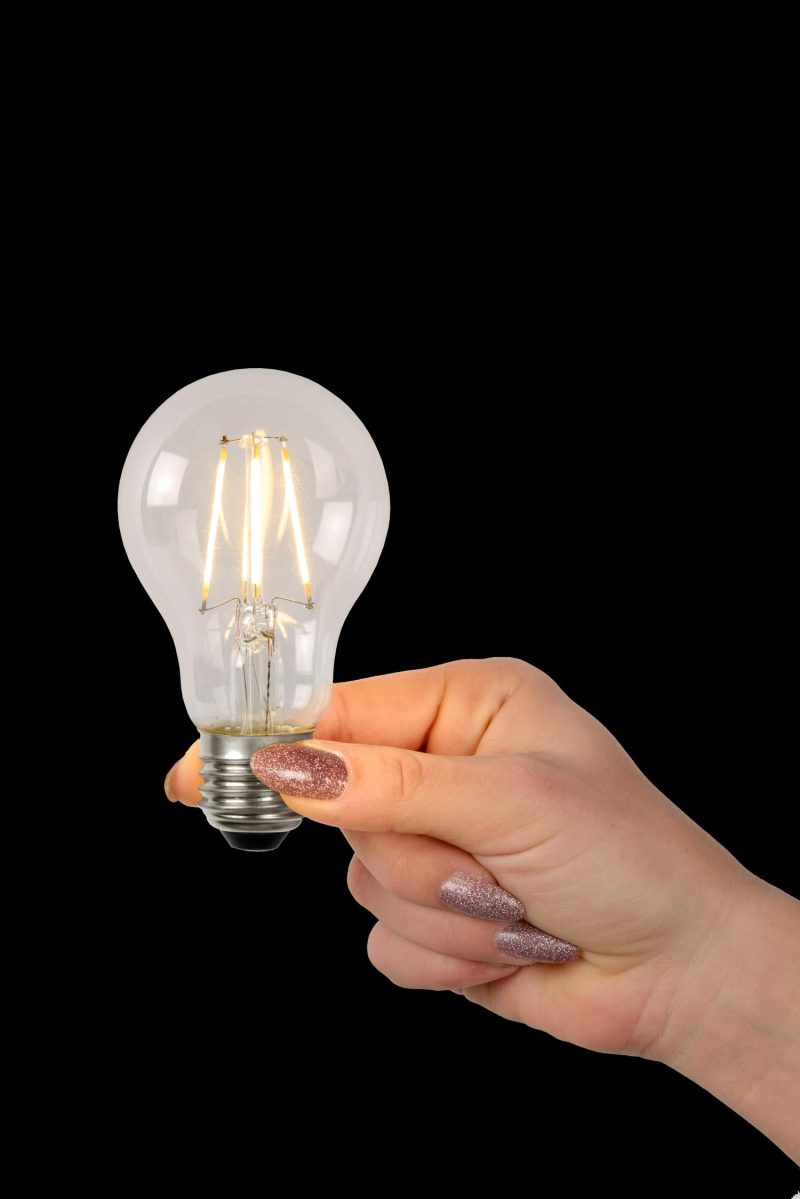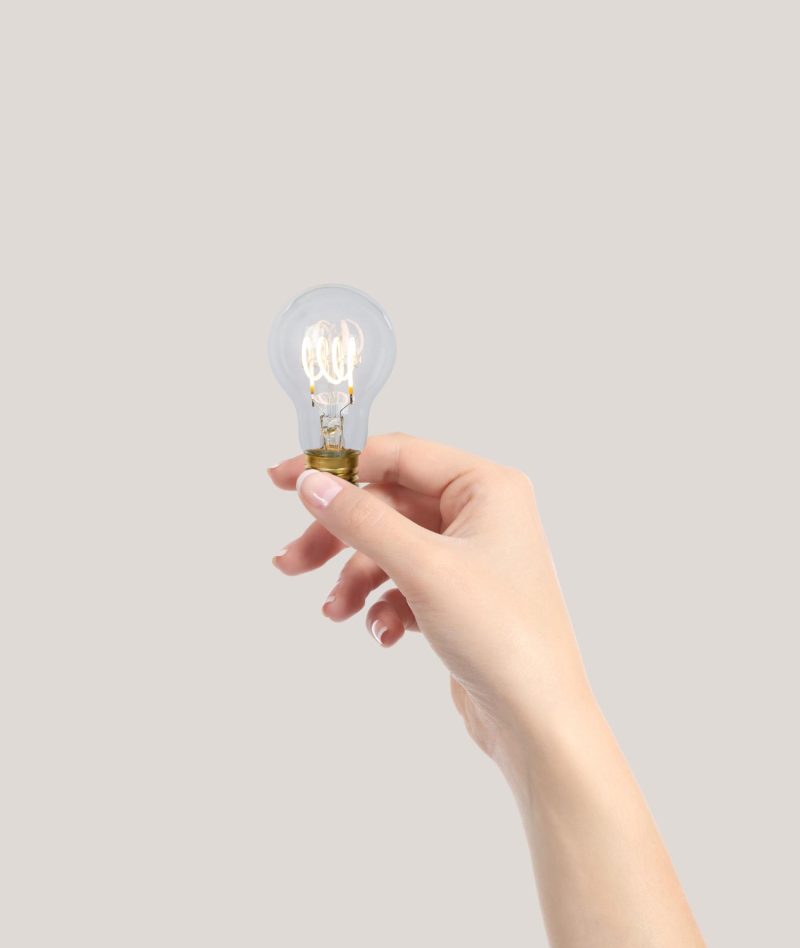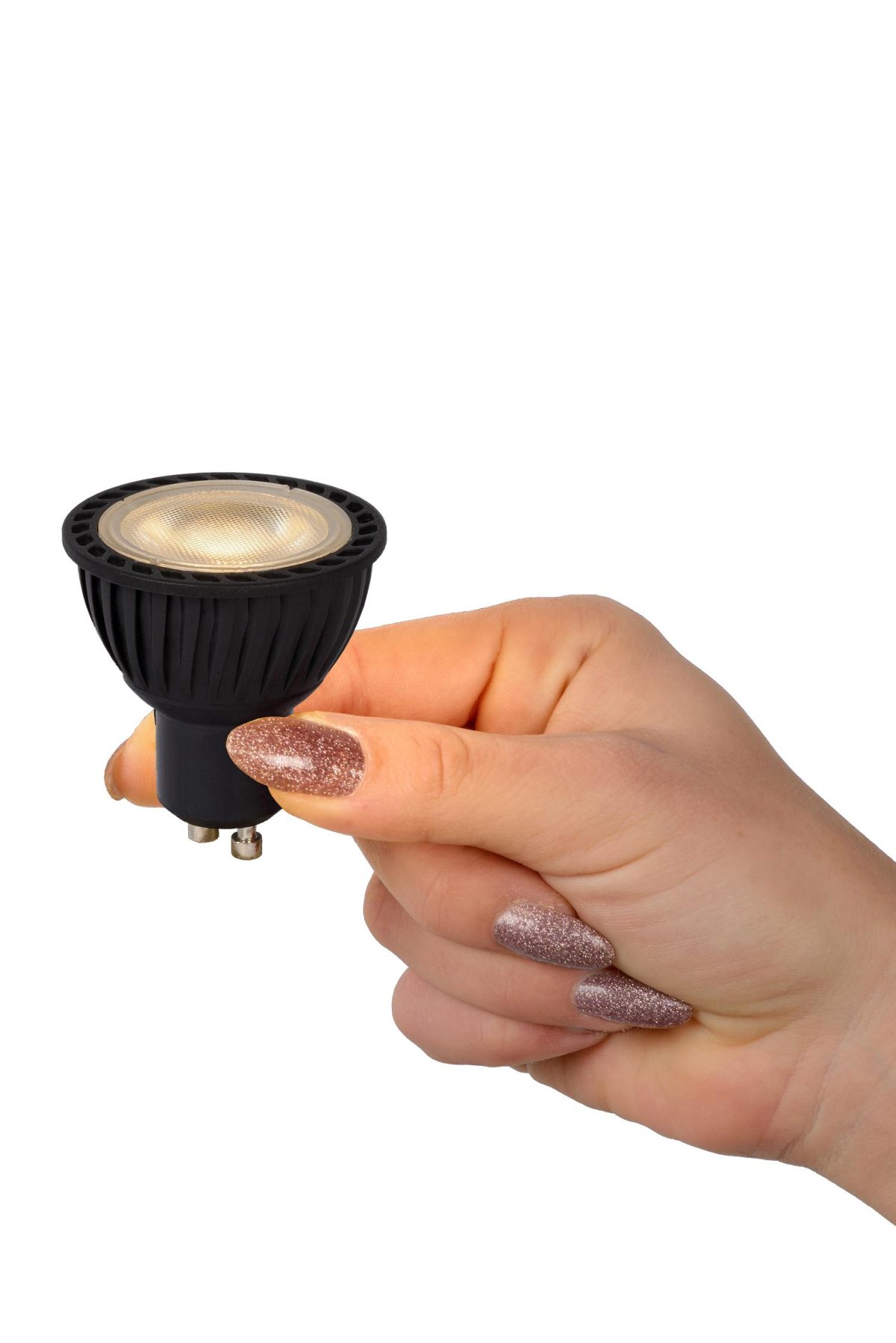
For the same light, an LED bulb uses roughly 85 to 95% less electricity than an incandescent or halogen bulb. Replacing a 50 W halogen spotlight with a 5 W LED spotlight saves about 49 kWh a year at three hours a day, or around €16 at €0.32 per kWh. An LED spotlight costing €7 to €12 then pays for itself in six to nine months. Bulbs that are rarely switched on pay for themselves much more slowly.
How much does a bulb use per year?
You work out a bulb’s consumption like this:
kWh per year = watts × hours of use per day × 365 ÷ 1000
A 50 W bulb that is on for three hours a day uses 50 × 3 × 365 ÷ 1000 = 54.75 kWh per year. Multiply by your electricity price and you know what it costs. The table assumes three hours of use per day and €0.32 per kWh; further down you can see where that figure comes from.
| Bulb | Wattage | kWh per year | Cost per year |
|---|---|---|---|
| 60 W incandescent bulb | 60 W | 65.7 | €21.02 |
| E27 LED bulb with 806 lumens | 3.8 W | 4.2 | €1.33 |
| 75 W incandescent bulb | 75 W | 82.1 | €26.28 |
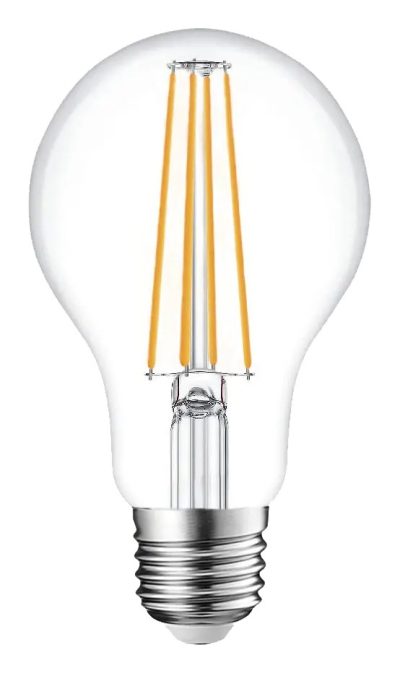
| E27 LED filament bulb with 1,300 lumens | 7 W | 7.7 | €2.45 |
| 50 W GU10 halogen spotlight | 50 W | 54.8 | €17.52 |
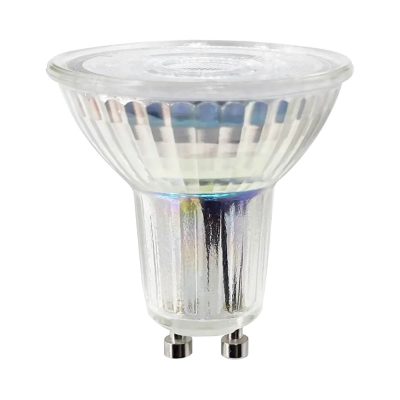
| GU10 LED spotlight with 350 lumens | 5 W | 5.5 | €1.75 |
How many LED watts replace an incandescent bulb or a halogen spotlight?
Compare light, not watts. For bulbs that shine in all directions, the European Union set out in Regulation 244/2009 when a bulb counts as equivalent to an incandescent bulb: 806 lumens for 60 W, 1,521 lumens for 100 W. The full table is in how many lumens per room.
Spotlights had a separate table, in Regulation 1194/2012. For each halogen reflector it gives the luminous flux within a 90-degree cone, the beam that matters. An ordinary halogen GU10 is a PAR16 reflector.
| Halogen reflector | Reference | LED replacement, example |
|---|---|---|
| PAR16 (GU10), 35 W | 200 lm | 5 W GU10 with 350 lm |
| PAR16 (GU10), 50 W | 300 lm | 6.25 W GU10 with 600 lm |
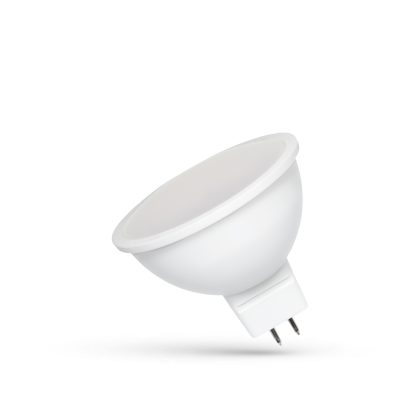
| MR16 (GU5.3, 12 V), 35 W | 300 lm | 12 V MR16 of 6 W with 580 lm |
| MR16 (GU5.3, 12 V), 50 W | 540 lm | 12 V MR16 of 6 W with 580 lm |
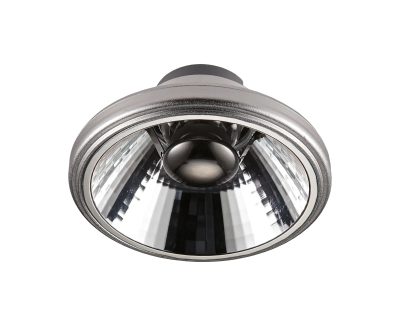
| AR111, 50 W | 390 lm | 12.4 W AR111 with 1,386 lm |
| AR111, 75 W | 640 lm | 12.4 W AR111 with 1,386 lm |
So a 5 W LED spotlight comfortably replaces a 50 W halogen GU10: ten times less power, and more light. With spotlights, look at the beam angle as well as the lumens, otherwise the light becomes a harsh patch or, the other way round, a soft haze.
Which electricity price should you use?
Your own price per kWh, from your bill or your contract. It differs by supplier, by contract and by month. If you want a reference figure, these are the most recent official numbers:
- Belgium. For the fourth quarter of 2026, the government uses 32.25 cents per kWh in Flanders, 36.88 cents in Brussels and 37.79 cents in Wallonia to reimburse home charging. These are average all-in prices from the CREG, covering energy, network charges, levies and VAT, over May, June and July 2026, for a household with a digital meter, an electric car and 8,000 kWh a year.
- European comparison. For the second half of 2025, Eurostat reports €0.3499 per kWh including taxes for Belgian households using 2,500 to 5,000 kWh, against an EU average of €0.2896.
- The Netherlands. According to CBS, the Dutch statistics office, an extra kWh in August 2026 cost on average €0.1469 in variable supply tariff and €0.1109 in energy tax, both including VAT: together about €0.26. The fixed charges and the tax reduction do not change with your consumption, so for a saving you only count that amount per kWh.
In Flanders there is one more factor. Since 1 January 2023 you pay roughly half of the network charges through a capacity tariff based on your highest monthly peak in kW, and the other half per kWh. Lighting hardly changes that peak. A kWh saved in Flanders is therefore worth slightly less than the average all-in price. If you want to calculate cautiously, use €0.30 there.
How quickly does LED pay for itself?
Electricity price
Result
See the LED bulbsHow long does an LED bulb last?
The lifespan of an LED bulb is given as L70B50: the number of operating hours after which half of a batch of bulbs gives less than 70% of their original light. That is how the European ecodesign regulation 2019/2020 defines it. So the measure is about gradually getting dimmer, not about suddenly failing.
Lucide states 25,000 hours for its dim-to-warm LED spotlight, LEDVANCE 50,000 hours for its COB LED strips. By comparison, according to licht.de an incandescent bulb lasted about 1,000 hours and a low-voltage halogen bulb up to 4,000 hours. At three hours a day, 1,000 hours is less than a year, and 25,000 hours is well over twenty years.
Those figures apply under the conditions in which they were measured. Heat shortens the lifespan most: an LED bulb in a small closed fixture or a recessed spotlight without ventilation does not always reach them. Leave space around the bulb, and choose a lower-wattage bulb in closed fixtures.
What does a spotlight cost over its whole lifespan?
For a bulb that is on a lot, the purchase price is the smallest part of the bill. Take the 25,000 hours of a good LED spotlight as the yardstick. Over that time a 50 W halogen spotlight uses 1,250 kWh, about €400 of electricity at €0.32, and you buy several replacements along the way. A 5 W LED spotlight uses 125 kWh, or €40, plus the purchase price of one bulb.
Per spotlight, that is a difference of well over €350 across its lifespan. In a kitchen with ten spotlights, it is an amount that would also buy you better fixtures. The other way round: a cheap LED spotlight that grows dimmer or starts to flicker after a few years never reaches that total, and the difference in purchase price is soon gone.
When does replacing pay off less?
- Bulbs that are rarely on. In a storeroom, an attic or a guest room, it takes years for an LED bulb to pay for itself. Replace them when the old one breaks.
- Bulbs that are already LED. A newer LED bulb is often slightly more efficient, but going from 7 to 5 W saves less than €1 a year at three hours a day.
- 12 V spotlights. 12 V LED spotlights do not always work with the transformer that was meant for halogen. If it has to be replaced, the investment goes up. See lamp bases explained.
- Dimmers. An old dimmer for halogen often works poorly with LED. Include an LED dimmer wherever you dim; see dimming LED bulbs.
How can you save more than with the bulb alone?
The biggest saving comes from switching to LED. After that, what helps most is fewer hours of use and less light where it is not needed:
- Dimming. A dimmed LED bulb draws less power. If you run it at a third in the evening, you use noticeably less than at full power.
- Motion sensors and dusk switches in hallways, on stairs, in storerooms and outdoors, where lights often stay on with nobody there.
- The right amount of light. A room with twice the lumens it needs uses twice as much as it needs. Work out what you really need in how many lumens per room.
- Smart bulbs in moderation. A smart bulb keeps using a little electricity even when switched off, so that it stays reachable. With a few bulbs that is negligible; with dozens, count it in.
Does the energy label tell you anything about the saving?
The most useful number on the label is not the letter but the consumption in kWh per 1000 hours. That equals the power in watts and goes straight into the formula above. The letter itself is strict: many good LED bulbs are in class E, F or G. You can read why in the energy label for lighting.
LED replacements for halogen and incandescent bulbs
View allLED bulbs that give at least as much light as the halogen or incandescent bulb they replace.
Frequently asked questions
Is it sensible to replace halogen bulbs that still work right now?
For bulbs that are on for at least an hour a day, yes: replacing a 50 W halogen spotlight with a 5 W LED spotlight then pays for itself in about two years or less, and in under a year at three hours a day. Bulbs that are rarely on can be replaced when they fail.
How much does a light that stays on all night cost?
A 5 W LED bulb that is on for ten hours a night uses 18.25 kWh a year: about €5.84 at €0.32. A 40 W incandescent bulb used in the same way takes 146 kWh, or €46.72 a year.
Are cheap LED bulbs just as efficient?
Not always. Compare lumens and watts on the packaging: a bulb giving 806 lumens at 3.8 W is more efficient than one giving 806 lumens at 8 W. In the EU, even cheap bulbs must meet minimum requirements for efficiency, colour rendering and flicker, but above that they differ, among other things in lifespan and in how well they dim.
What should I do with my old bulbs?
Take them to a collection point for lamps, such as a recycling centre. Energy-saving bulbs and fluorescent tubes contain mercury and do not belong in general waste. LED bulbs also contain electronics that get recycled.
Sources
- Circulaire 2026/C/86 over de terugbetaling van elektriciteitskosten voor thuisladen: maximaal vast tarief per kWh, vierde kwartaal 2026 (op basis van CREG-prijzen), FOD Financiën, samengevat door Forum for the Future (2026)
- Nieuwe forfaitaire bedragen voor thuisladen van elektrische wagens in het vierde kwartaal van 2026, Securex (2026)
- Electricity price statistics (tweede helft 2025), Eurostat (2026)
- Gemiddelde energietarieven voor consumenten (tabel 85592NED), CBS (2026)
- Wat betekent de invoering van het capaciteitstarief vanaf 2023 voor jou?, Test Aankoop (2022)
- Commission Regulation (EC) No 244/2009, Annex II, Table 6, EUR-Lex, European Union (2009)
- Commission Regulation (EU) No 1194/2012, Annex III, Table 6, EUR-Lex, European Union (2012)
- Commission Regulation (EU) 2019/2020 laying down ecodesign requirements for light sources (definition of L70B50), EUR-Lex, European Union (2019)
- licht.wissen 14: Ideas for Good Home Lighting (levensduur gloeilamp en halogeen), licht.de (2009)
- MR16 Led bulb, Dim to warm, GU10 (levensduur 25.000 uur), Lucide (geraadpleegd 2026)
- LEDVANCE COB LED Strip (L70/B50 50.000 uur bij Tc 65 °C), LEDVANCE (2021)