For lighting in the home, preferably choose a 24 V LED strip: at the same power, half as much current flows as at 12 V, so the voltage loss is proportionally four times smaller. For ambient light, 5 to 10 W per metre is enough; for worktop lighting, allow about 1,000 lumens per metre. Mount the strip in an aluminium profile, take a power supply with about 20% headroom, and feed a strip longer than 5 m at more than one point.
12 or 24 volts: what is the difference?
An LED strip runs on low DC voltage, usually 12 or 24 V, and needs a power supply that converts the mains voltage. The difference between 12 and 24 V looks like a detail, but it determines how long the strip can be without the end getting dimmer.
The reason is physics. Power is voltage times current. A 5 m strip at 10 W per metre needs 50 W. At 12 V that takes 4.2 A, at 24 V only 2.1 A. Every copper wire has resistance, and the voltage loss across a wire is current times resistance. Halve the current and you halve the loss in volts, and relative to a voltage twice as high, the loss is then only a quarter.
Choose 12 V for short runs, such as a display cabinet or a small niche, or if you are connecting to an existing 12 V system. For everything else, 24 V is the sensible standard: you can feed longer runs and work with thinner cables.
There are also strips that run directly on 230 V, without a separate power supply. That saves a component, but mains voltage is then present along the whole length. With such a strip, only use the manufacturer’s connectors and end caps, cut only at the marked points, and mount it in a closed profile.
How many watts and lumens per metre do you need?
Look at the lumens per metre, not the watts. How much light a strip gives per watt varies widely: in our own range, from about 75 to 140 lumens per watt. Two strips of 10 W per metre can therefore give 780 or 1,200 lumens per metre.
| Application | Power | Luminous flux | Tip |
|---|---|---|---|
| Ambient light in a ceiling cove or along a skirting board | 4–8 W/m | 300–700 lm/m | Make it dimmable |
| Behind a TV or under a bed | 4–5 W/m | 300–500 lm/m | It is about the glow, not about light |
| Cabinet, display case or bookshelf | 5–10 W/m | 400–1000 lm/m | High colour rendering for what is inside |
| Worktop under kitchen wall units | 10–15 W/m | 1000–1500 lm/m | At the front of the unit, with an opal diffuser |
| Main lighting via a light line | 15–20 W/m | 1500–2500 lm/m | Only with a good cooling profile |
SMD or COB: points of light or an even line?
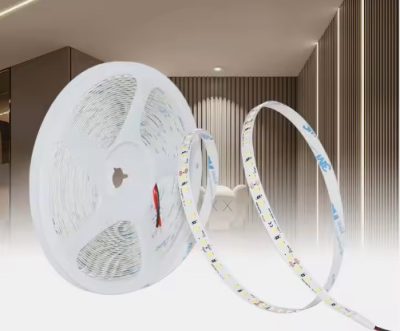
An SMD strip has individual LEDs at a fixed spacing, usually 60 or 120 per metre. The codes in the product name, such as 2835 or 5050, are the dimensions of the LED in tenths of a millimetre. If you can see the strip or its reflection in a glossy worktop, you see a row of dots.
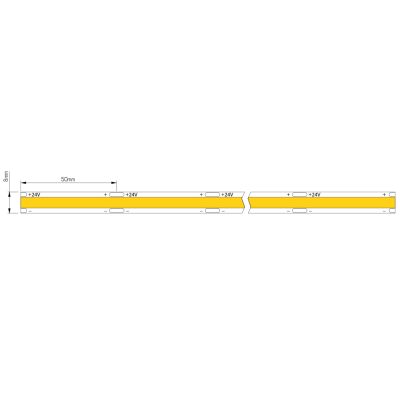
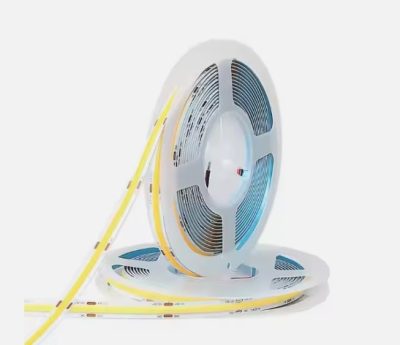
A COB strip (chip on board) has so many small chips close together, 320 to 528 per metre in our range, under a continuous phosphor layer, that the light forms an even line. LEDVANCE describes its COB strips as a homogeneous line of light without visible dots, cuttable every 62.5 mm. For a skirting board, an open cabinet or anything you see directly, COB is the better choice. An SMD strip in a deep profile with an opal cover comes close.
What colour temperature and colour rendering does an LED strip have?
A white strip has one colour temperature, usually 2700, 3000 or 4000 K. In the home, use the same colour temperature as the lights next to it; how to choose is explained in choosing a colour temperature. A CCT strip has two kinds of white LEDs, warm and cool, and lets you choose the colour temperature with a controller.
An RGB strip mixes red, green and blue into any colour, but its white is mediocre. For good white alongside colour, take RGBW, with a separate white LED, or RGBW with tunable white. Such strips have more connections and a controller with more channels.
Colour rendering differs too. LEDVANCE states a colour rendering above Ra 90 for its COB strips. For a wardrobe with clothes or a worktop, that is the difference between true and dull colours; see colour rendering and CRI.
Which IP rating does an LED strip need?
The IP code tells you how well the strip is protected against dust and water. A bare strip is usually IP20: for dry rooms only. Strips with a silicone coating, IP44 or IP54, withstand splashing water, for example above a kitchen worktop. Strips in a silicone sleeve, IP65 to IP67, are for outdoor use; IP67 even withstands brief immersion.
Do not forget the power supply: it has its own IP rating, and an IP20 power supply belongs in a dry, accessible place outside the wet zone. In the bathroom, the zones determine what is allowed where; the rules per zone are in bathroom lighting and IP zones.
Why does an LED strip belong in an aluminium profile?
Above all because of the heat. LEDs lose light faster as they get warm. LEDVANCE states a lifespan of 50,000 hours (L70/B50) for its COB strips, but only as long as the measuring point on the strip does not get warmer than 65 °C. An aluminium profile carries the heat away; a strip stuck directly onto wood or plastic, or in a closed cove, can reach that limit at higher power ratings.
The cover determines the light. A clear cover gives the most light and shows the dots; an opal or milky-white cover diffuses the light and costs some lumens. The deeper the profile, the more even the line with the same cover.
Check the inside width: strips are 5, 8, 10 or 12 mm wide, and the strip must lie flat on the bottom of the profile. There are surface-mounted profiles, recessed profiles that you set into a groove or into plasterboard, and corner profiles that direct the light at 45 degrees.
Which power supply do you need?
An LED strip needs a constant voltage (CV) power supply of the same voltage as the strip, 12 or 24 V. Constant current (CC) power supplies, specified in milliamps, are for LED modules and spotlights, not for strips. Power supply manufacturer Mean Well puts it the same way: strips are fed with CV.
You calculate the power as watts per metre times the length. Add about 20% to that. Mean Well lets its LED drivers run at full power as long as the temperature stays within the specifications, so the headroom is not for the power supply itself. It covers the tolerance on the strip’s power, the heat in a small space and the metre you add later.
Place the power supply where it is accessible and with some air around it, never wrapped in insulation. And think about the cable to the strip: the longer and thinner it is, the more voltage is lost.
Dimming and control
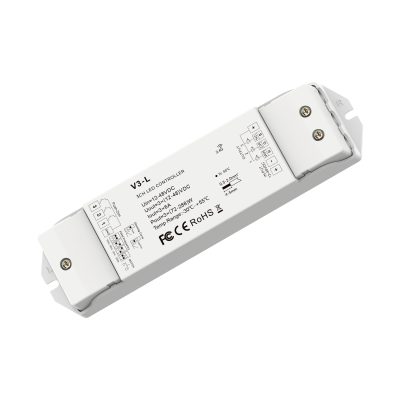
There are three ways to dim a strip. A triac-dimmable power supply works with an ordinary LED wall dimmer. A DALI power supply works with a DALI system. Or you put a controller between an ordinary power supply and the strip, operated with a remote control, an app or a wall button; for CCT and RGB strips that is the only way. Which dimmer suits a triac power supply is explained in dimming LED bulbs.
Which power supply and cable for your LED strip?
Voltage
Dimming
Result
See the LED stripsHow long can an LED strip be per feed point?
That is in the strip’s datasheet, and it also depends on the cable leading to it. LEDVANCE gives a table for this with its 24 V COB strip of 1,000 lumens per metre, fed with a 0.5 mm² cable: the strip can be 5.0 m long with a cable shorter than half a metre, 4.8 m with 1 m of cable, 4.5 m with 3 m, 4.1 m with 6 m and still 3.4 m with 10 m of cable. The manufacturer feeds a 10 m strip at two points.
If the strip is too long, the end lights more weakly than the start. With colour strips, the end can also shift in colour, because the red, green and blue LEDs respond differently to a lower voltage. There are three solutions:
- Feed in the middle. An 8 m strip then becomes two 4 m runs from the same point.
- Feed at both ends. A second cable from the power supply to the other end pulls the voltage up there.
- Wire in parallel. Each run gets its own cable to the power supply, in a star. That is the neatest solution for a light line around a whole room.
For the cable between the power supply and the strip, a larger cross-section helps. A practical rule of thumb is to keep the loss across the cable below 3%.
| Cross-section | Resistance per km | Resistance per m |
|---|---|---|
| 0.5 mm² | 39.0 Ω | 0.039 Ω |
| 0.75 mm² | 26.0 Ω | 0.026 Ω |
| 1.0 mm² | 19.5 Ω | 0.0195 Ω |
| 1.5 mm² | 13.3 Ω | 0.0133 Ω |
| 2.5 mm² | 7.98 Ω | 0.008 Ω |
Cutting, connecting and mounting without mistakes
- Only cut at the marking. Between two cutting points there is a fixed group of LEDs. On COB strips those points are close together; on 24 V SMD strips they are further apart than on 12 V ones.
- Choose the right connector. A connector has to match the width of the strip (8, 10 or 12 mm), the type (COB or SMD) and the number of contacts: an RGB strip has four, an RGBW strip five.
- Mind plus and minus. A strip only works one way round: connect it in reverse and it does not light.
- Clean the surface. The adhesive tape sticks poorly to dust and grease. Degrease the profile or cabinet first.
- Follow the manufacturer’s bending radius. Too sharp a bend breaks the copper tracks. Corner connectors exist for right angles.
- Measure twice. Order to the real lengths, count the sections between the cutting points, and take the position of the power supply into account.
24 V LED strips
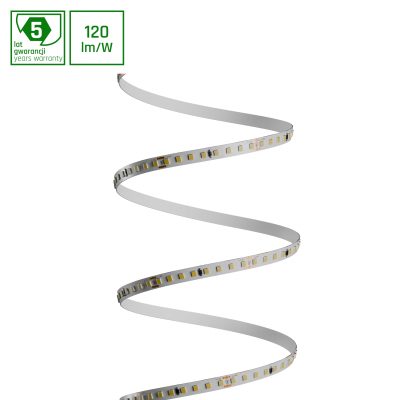
View allWhite strips of 10 to 18 W per metre, as SMD with points of light or as COB with an even line.
Power supply, profile and control
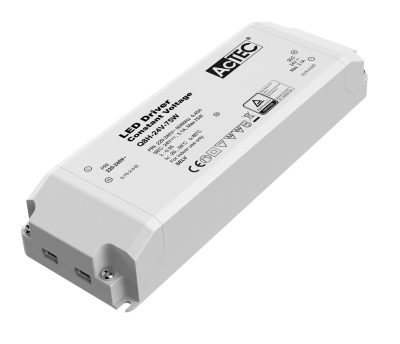
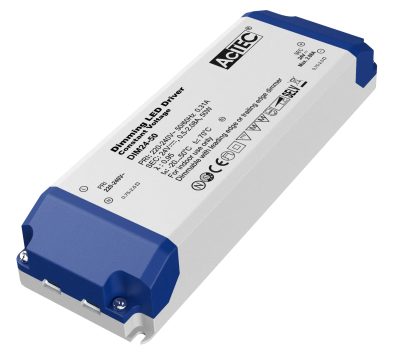
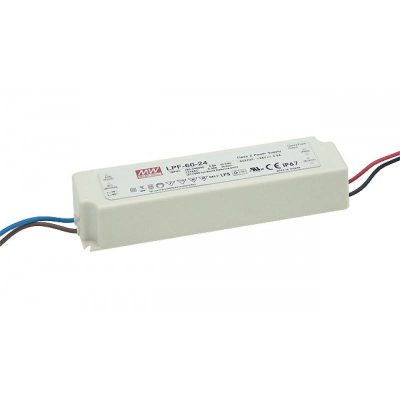
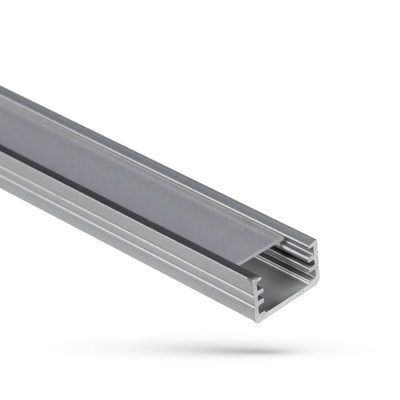
View all24 V constant voltage power supplies, dimmable and non-dimmable, aluminium profiles with cover, and a controller.

Frequently asked questions
Can I shorten an LED strip?
Yes, at the cutting marks. If you cut in between, the last section no longer works. On a waterproof strip, seal the cut end with an end cap from the same manufacturer, otherwise the strip loses its IP rating.
Can I join two LED strips together?
Yes, with a connector of the same width and type, and only if both strips have the same voltage. Watch the total length: two 5 m strips in a row are one 10 m strip, with the voltage loss of 10 m. Two separate cables to the power supply work better.
How long does an LED strip last?
That depends mainly on the temperature. LEDVANCE states 50,000 hours (L70/B50) for its COB strips, which means that after that time half of the strips still give at least 70% of their light, provided the measuring point does not get warmer than 65 °C. A good profile is therefore not decoration.
Why is the end of my RGB strip a different colour?
Because of voltage loss along the length. Red, green and blue LEDs each respond differently to a lower voltage, so the mixed colour shifts at the end. Feed the strip at both ends or in the middle.
Can an LED strip go behind the TV without a profile?
A low-power strip, around 4 to 5 W per metre, on the metal back of a TV gives off little heat and can go without a profile. For higher power ratings, for places where you can see the strip, or on wood and plastic, an aluminium profile is better.
Sources
- Neu im LED Strip System: LEDVANCE COB LED Strip (productinformatie en tabel met voedingslengtes), LEDVANCE (2021)
- Conductor resistance volgens IEC 60228 / EN 60228, Bayka (geraadpleegd 2026)
- LED driver Q&A: selectie, dimmen en belasting, MEAN WELL (geraadpleegd 2026)
- Küche: Lichtanwendungen Wohnen, licht.de (geraadpleegd 2026)