The colour rendering index, shown as CRI or Ra, tells you how faithfully a lamp shows colours, on a scale up to 100. Ra 80 is the European minimum for most light sources and is enough in living spaces; in the kitchen, at the bathroom mirror and for art or clothing, Ra 90 or higher pays off. Also look at R9, the rendering of saturated red: it is not part of Ra and can be low with ordinary LEDs.
What does the colour rendering index measure?
The colour rendering index (Ra) tells you how much colours under a lamp differ from the same colours under a reference light with the same colour temperature. A score of 100 means no difference; lower scores mean that colours look duller or shifted.
The method was laid down by the International Commission on Illumination (CIE) in publication CIE 13.3. Eight defined test colours, muted shades from red to purple, are measured under the lamp and under the reference light, and the difference is calculated for each colour. The average of those eight is the general index Ra. CIE 13.3 also has six additional test colours that do not count towards Ra: a saturated red, yellow, green and blue, a skin tone and a leaf green. The saturated red is called R9, and we will come back to it.
An incandescent bulb and a halogen lamp have a colour rendering of 100: their light is the reference light. Licht.de, the knowledge centre of the German lighting industry, writes that good LED lamps reach up to Ra 98, but that quality varies widely between products.
What do you see at Ra 80, 90 and 95?
Since September 2021, most light sources sold in the EU must have a colour rendering of at least 80. Lower values are only still allowed for light sources for outdoor and industrial use, and for a few very powerful discharge lamps. Licht.de recommends Ra 80 as the minimum for indoor spaces and Ra 90 or higher where colours need to come across well.
| Ra | What you see | Where |
|---|---|---|
| Below 80 | Dull colours, greyish skin, brownish red | Outdoors, garage, storage room |
| 80–89 | Colours recognisable, red and skin somewhat flat | Living room, bedroom, hallway |
| 90–94 | Red, skin and wood clearly more natural | Kitchen, dining table, bathroom, wardrobe |
| 95 and higher | Hardly any difference from halogen | Make-up mirror, paintings, hobbies involving colour |
The difference between 80 and 90 sounds small. Side by side you see it straight away: under Ra 80 a tomato looks duller and browner, under Ra 95 a deeper red. Under Ra 80 skin takes on a greyish tinge, and an oak floor loses part of its warm tone.
Why should you look at R9 separately?
Ra only uses muted test colours, and a saturated red is precisely what is not among them. A white LED usually makes its light with a blue chip and a phosphor layer that converts part of that blue. There is little deep red in it. A lamp can therefore reach Ra 80 with a low or even negative R9.
How low the bar is can be seen in the American ENERGY STAR label: for LED lamps it requires an Ra of at least 80 and an R9 above zero. That is a lower limit, not a quality level. For a kitchen, a dining table or a mirror we recommend an R9 of at least 50. If R9 is not listed in the product data, Ra 90 is the best indication you have.
R9 matters because so much of what we judge contains red: meat, tomatoes, red peppers, wine, lips, the blood flow in skin. Under light with a low R9, food looks less fresh and a face more tired.
Where does colour rendering matter most?
- Kitchen. Licht.de asks for at least Ra 80 for all light sources in the kitchen, so that you can judge the quality of food and how well it is cooked. Above the worktop, Ra 90 pays off. More in kitchen lighting.
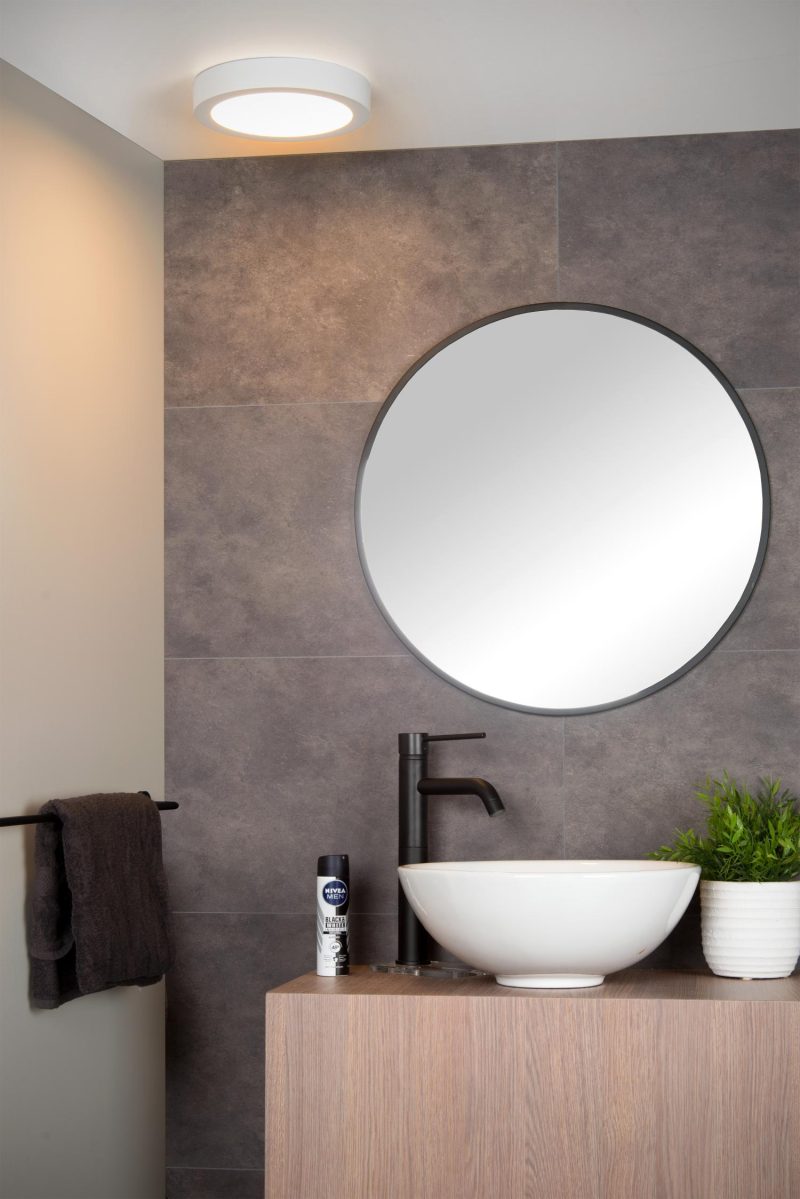
- Bathroom mirror. Make-up, shaving and judging skin call for high colour rendering and light from the sides. Here Ra 90 is a lower limit and Ra 95 is worth it. See bathroom lighting.
- Dining table. Food and faces at the table, under a pendant light you see from close by.
- Wardrobe and dressing room. Telling black from navy only works with good light and good colour rendering.
- Art, books and plants. A painting under Ra 80 is a different painting. Leaf green (R14) and skin tones (R13) stand out with plants and portraits.
- Hobbies and work involving colour. Sewing, painting, photo editing: choose Ra 95 and a neutral colour temperature.
In a living room, bedroom or hallway, Ra 80 is usually enough. If it costs you nothing extra, Ra 90 is a gain there too.
Lamps and light fittings with a colour rendering of Ra 90 or higher
View allRa 90 or higher according to the product name or the manufacturer.
Colour rendering and colour temperature are two different things
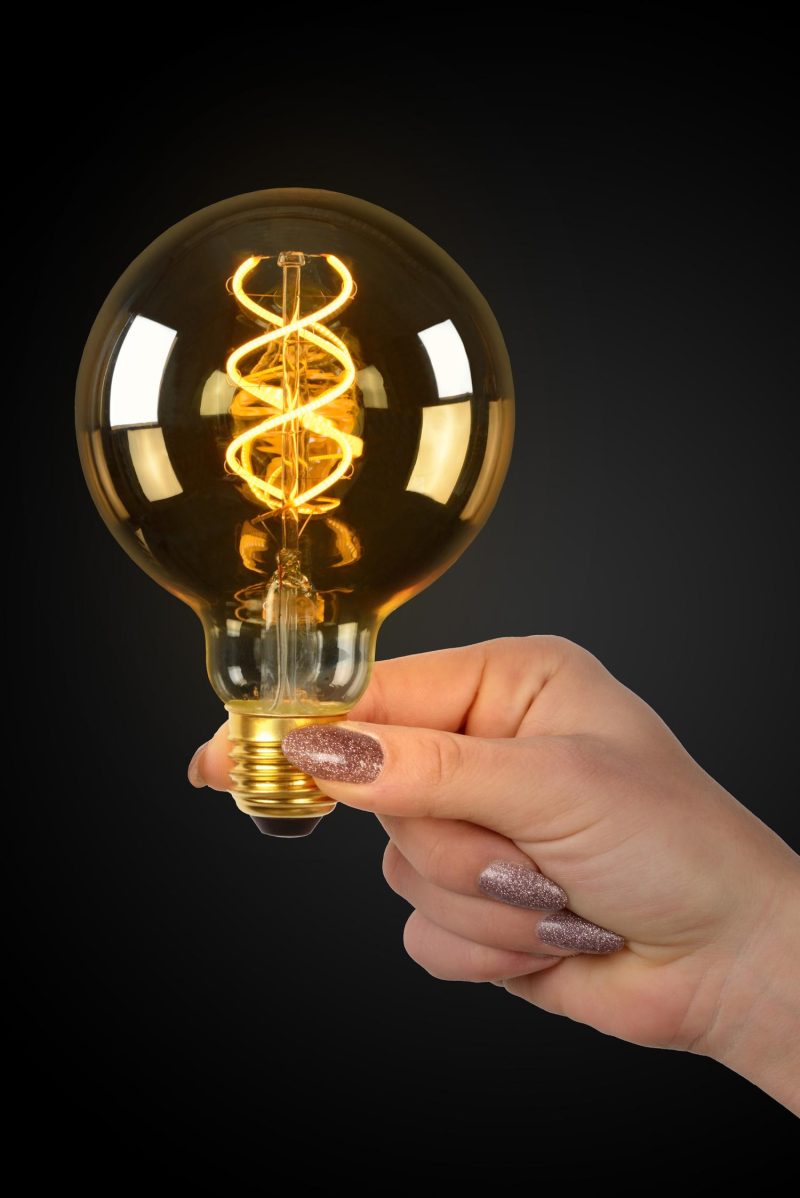
Colour temperature, in kelvin, tells you whether the light looks warm or cool. Colour rendering tells you how faithful the colours are at that colour temperature. An amber filament bulb of 2200 K with Ra 90 makes everything warm and orange, but within that warmth you can tell red, brown and purple apart well. A 4000 K lamp with Ra 80 is bright and cool, but red and skin look flat under it.
Because Ra compares against a reference with the same colour temperature, a high Ra says nothing about whether the light resembles daylight. How to choose the colour temperature is explained in choosing a colour temperature.
How do you read colour rendering on the packaging?
Under the European ecodesign rules, the colour rendering must be stated on the packaging of every light source, and in the European product database EPREL, which you open via the QR code on the energy label. You often also see a three-digit code, such as 827, 930 or 940. The first digit is the colour rendering class: 8 for Ra 80 to 89, 9 for Ra 90 and above. The last two digits are the kelvin divided by a hundred. A 927 is therefore 2700 K with at least Ra 90.
Be wary of “high colour rendering” without a number. A manufacturer that reaches Ra 95 says so, and a good manufacturer also states R9.
Why do two lamps with the same Ra still look different?
Because Ra is an average. Two lamps with Ra 90 can score on the eight test colours in different ways: one is strong in red and weaker in blue-green, the other the other way round. The average is the same, the picture is not. That is why the additional indices, such as R9 for red and R13 for skin, say more about a specific use than Ra alone.
The shade of white can also differ, even at the same kelvin: one white leans a fraction towards pink, the other towards green. That has to do with colour consistency, not with colour rendering. The European rules allow a deviation between individual units of up to a six-step MacAdam ellipse. In a row of spotlights on a white wall, that can be visible. More on this in choosing a colour temperature.
LED strips and light fittings with built-in LEDs
With a light fitting with built-in LEDs, you choose the colour rendering together with the fitting, because you cannot later replace the lamp with a better one. So check the product data before you buy. With LED strips the differences are large: COB strips, with a continuous line of light without dots, reach Ra above 90 with some manufacturers. LEDVANCE, for example, states this for its COB strips. For a strip under kitchen cabinets, that is the difference between a worktop that looks clean and one that looks grey.
Does high colour rendering cost energy?
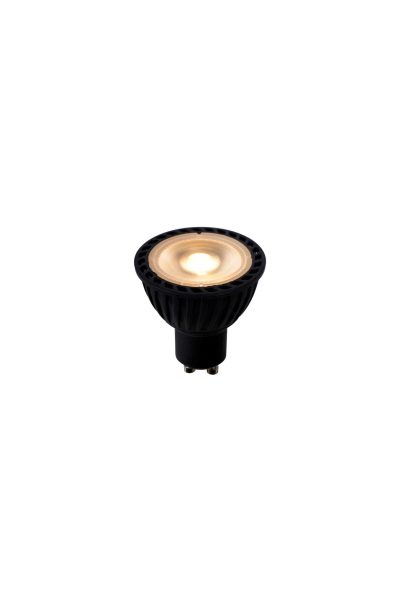
A little. To show red and skin well, a lamp has to give more light in the red part of the spectrum, where the eye is less sensitive. That costs lumens per watt. Lucide states a colour rendering of 95 and a luminous flux of 320 lumens at 5 W for its dim-to-warm GU10 spotlight. That is 64 lumens per watt, and Lucide lists energy class G for that lamp. It still uses a tenth of what a halogen spotlight does. Why such lamps score low on the label is explained in the energy label for lighting.
For most rooms, that difference does not outweigh colours that look better. In a hallway where the light is on all night, Ra 80 with a higher light output can be the better choice.
Is there a better measure than Ra?
In 2017 the CIE published a newer index, CIE 224, with 99 test colours instead of eight. That score, Rf, describes colour fidelity more accurately. The CIE itself adds that Rf does not replace Ra, neither for product data nor for regulations. Some manufacturers list Rf alongside Ra, together with a measure of saturation, Rg, according to an American method. If you come across these: a high Rf means faithful, an Rg above 100 means slightly more saturated than the reference.
How do you test colour rendering at home?
Place a few strongly coloured objects under the lamp: a red tomato or apple, a piece of vegetable, a colourful book, your own hand. Compare with a second lamp of the same colour temperature, side by side. Comparing different colour temperatures makes no sense: you then see the colour difference of the light, not the colour rendering.
Do not use a photo as proof. A phone camera corrects colour automatically and smooths out exactly the differences you want to see.
Frequently asked questions
Does a filament bulb have good colour rendering?
That varies by bulb: filament bulbs exist with Ra 80 and with Ra 90 or higher. Amber glass makes the colour of the light warmer, but does not change the index. Check the value on the packaging or in the product data.
Can an LED lamp be as good as a halogen lamp?
Almost. Halogen has Ra 100; according to licht.de, good LED lamps reach up to Ra 98. Above Ra 95 you hardly see any difference in a home, especially if R9 is also high.
What is good colour rendering for a make-up mirror?
At least Ra 90, preferably 95, with a high R9 for lips and skin. At least as important is the position: light from the left and right of the mirror lights a face evenly, light from directly above casts shadows under the eyes and nose.
What does “Ra > 90” mean in a product name?
That the general colour rendering index is above 90. It says nothing about R9 or about the colour temperature. For a kitchen or mirror it is a good sign; if in doubt, ask for the R9.
Why do colours look different in the shop than at home?
Because three things differ at once: the amount of light, the colour temperature and the colour rendering. A fabric you chose under bright 4000 K light looks warmer and darker at home under 2700 K. So compare samples in the light where they will hang, or in daylight.
Sources
- CIE 13.3-1995: Method of Measuring and Specifying Colour Rendering Properties of Light Sources, Commission Internationale de l’Éclairage (CIE) (1995)
- CIE 224:2017: CIE 2017 Colour Fidelity Index for accurate scientific use, Commission Internationale de l’Éclairage (CIE) (2017)
- Farbwiedergabe, licht.de (geraadpleegd 2026)
- Küche: Lichtanwendungen Wohnen, licht.de (geraadpleegd 2026)
- licht.wissen 14: Ideas for Good Home Lighting, licht.de (2009)
- Regulation (EU) 2019/2020 laying down ecodesign requirements for light sources, Annex II, EUR-Lex, European Union (2019)
- ENERGY STAR Program Requirements for Lamps, Version 2.1, U.S. Environmental Protection Agency (2017)
- Neu im LED Strip System: LEDVANCE COB LED Strip (Ra > 90), LEDVANCE (2021)
- MR16 Led bulb, Dim to warm, GU10, 2200K/3000K, Lucide (geraadpleegd 2026)