A rechargeable table lamp usually lasts 5 to 10 hours at full power and a few days on the lowest setting. You can check it yourself: battery capacity in mAh times voltage divided by 1,000 gives watt-hours, and watt-hours divided by the wattage gives hours. A lamp rated IP44 can withstand a shower of rain, IP54 is also better protected against dust and IP65 is dust-tight and resistant to water jets. Charge it indoors at room temperature, and in winter store the lamp indoors with the battery half full.
A rechargeable lamp runs as long as its battery allows, and the brighter it shines, the shorter that is. At full power, for most table lamps that means one evening, 5 to 10 hours. On the lowest dimming setting it is a few days. You can check what the manufacturer states with a simple calculation, and that also lets you compare lamps that each state something slightly different.
The second question is always the same: can it stay outside? The answer is in the IP code, but that only says something about water and dust. It says nothing about cold, charging or the lifespan of the battery, and that is where the real difference lies between a lamp that lasts three summers and one that runs for only an hour after a single winter.
How long does a rechargeable lamp last, and how do you work it out?
Manufacturers usually state the battery capacity in milliamp-hours (mAh) and the voltage in volts. Lithium-ion batteries in lamps typically run at 3.7 V. This is how you calculate it:
- Energy in the battery (Wh) = mAh × V ÷ 1,000.
- Run time (hours) = Wh ÷ wattage of the lamp in watts.
The result is an estimate: the electronics use a little themselves, and at low dimming settings a lamp often runs more efficiently than the calculation predicts. The manufacturer’s figure is therefore what counts, but the calculation tells you whether that figure refers to full power or to the lowest setting. That is not always stated.
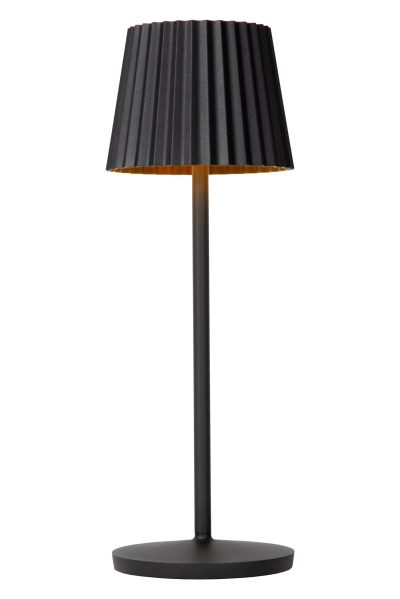
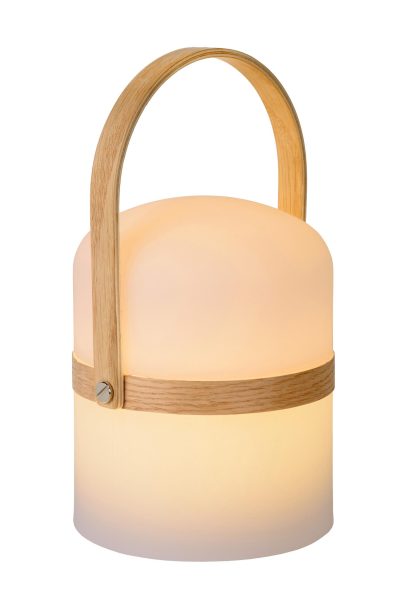 LUCIDE JOE rechargeable table lamp outdoor, battery/accu, Ø 14.5 cm, LED dim.
The lamp from the worked example: 270 lumens, IP44, three dimming settings and a 4,000 mAh battery. On the lowest setting it runs for 72 hours according to the manufacturer, enough for a week of summer evenings on the terrace. €94.46
How much light does a rechargeable lamp give?
Less than you are used to from a lamp on the mains. Most rechargeable table lamps give 50 to 350 lumens. For comparison: an ordinary LED bulb in an indoor table lamp easily gives 400 to 800 lumens. On a terrace or balcony that is not a problem, because outside everything is dark and a little light stands out straight away. Licht.wissen 14, the licht.de brochure on light in the home, explicitly calls rechargeable LED lamps for balcony and terrace practical: you put them where you need light, they are usually dimmable and you charge them with a smartphone cable.
Indoors a rechargeable lamp is mainly useful in places without a socket: a dining table in the middle of the room, a shelf, a side table next to an armchair. As the only light in a room it is not enough; for that, read lighting a rented home without drilling.
Can a rechargeable lamp stay outside when it rains?
Look at the IP code. The first digit is about dust and solid objects, the second about water. Licht.de lists what they mean:
| IP code | Protection | Outdoors in practice |
|---|---|---|
| IP20 | Against solid objects larger than 12 mm, not against moisture | Indoors only, not in a damp place |
| IP44 | Against objects larger than 1 mm and against splashing water | It will survive a shower on the terrace; do not leave it standing in a puddle |
| IP54 | Better protected against dust, and against splashing water | Like IP44, with better protection against dust and sand |
| IP65 | Dust-tight and protected against water jets | Can stay outside longer, even in heavy rain |
| IP67 | Dust-tight and resistant to temporary immersion | For example by a swimming pool or pond |
Lucide writes in its manuals that indoor products must not be used in damp places. So you do not put an IP20 lamp on a terrace, not even under a canopy where moisture hangs in the air. Two things the IP code does not tell you:
- Charge it indoors. The charging port is the vulnerable point. After rain, let the lamp dry before you plug in the cable.
- Cold is bad for the battery. Bebat, the Belgian organisation that collects batteries, writes about bike batteries that the range can drop sharply at low temperatures, and advises charging indoors at room temperature. The same principle applies to the lithium-ion battery in a lamp.
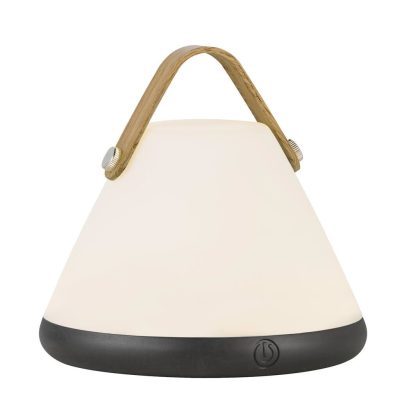
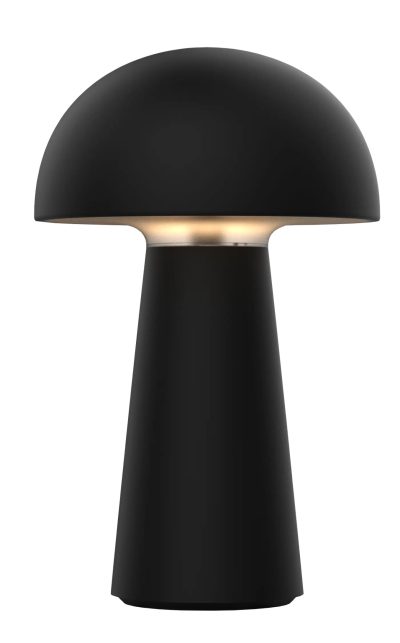
Rechargeable lamps that can handle water
View allAll IP44 or higher, from a small table lamp to a 1.33 m floor lamp.


How do you keep the battery healthy for years?
A lithium-ion battery does not last for ever, and in many rechargeable lamps you cannot replace it. For the Joe from the worked example, for instance, it is stated explicitly that the battery cannot be replaced. How you charge and store it therefore determines how long the whole lamp lasts. Bebat gives these rules of thumb:
- Avoid completely full and completely empty. Both 100 and 0 percent put strain on the battery. Bebat advises staying between roughly 20 and 90 percent where possible.
- Avoid heat. A lamp that stands on a table in full sun all day loses capacity faster. Prolonged heat shortens the lifespan of the battery.
- Store it indoors in winter, dry and at room temperature, with the battery at least half full and ideally around 80 percent. Top it up in between if it lies unused for months.
If after years the battery no longer works and cannot be replaced, the lamp belongs with electrical waste, not with household rubbish. Lucide points out in its manuals that the law requires electrical and electronic equipment to be collected separately for reuse and recycling.
What else should you look for when choosing?
- How do you charge it? With a USB cable, on a charging base, or wirelessly. A charging base or a magnetic connector is handy if the lamp moves back and forth a lot; a USB-C port means you can use your phone charger.
- Dimming settings and memory. Some lamps dim continuously with a touch button, others in three steps. A lamp that remembers which setting it was on saves a few taps every evening.
- Colour temperature. Most rechargeable lamps run at 2700 to 3000 K, warm white. Outdoors that is also what you want: cooler light on a terrace soon feels like work lighting.
- Weight and base. A light lamp blows over more easily. On a windy balcony, a heavier base or a lamp that stays low on the table is not a detail.
For fixed lighting on a terrace or in the garden, with cables and switches, read outdoor lighting.
Frequently asked questions
Can I leave a rechargeable lamp on the charger?
The charging electronics usually stop by themselves when the battery is full. For the lifespan of the battery it is better, though, not to keep it at 100 percent for months. Unplug the charger once the lamp is full and you are not going to use it for a while.
Why does my rechargeable lamp run for less time in autumn than in summer?
Cold temporarily reduces the capacity of a lithium-ion battery. A lamp standing outside in the evening at 5 degrees runs for less time than at 20 degrees. Charge it indoors at room temperature and you get the most out of the charge.
Can I use a rechargeable lamp while it is charging?
That varies by model. Check the manual of your lamp: some manufacturers allow it, others advise against it, and charging then takes longer in any case.
Is a rechargeable lamp sustainable?
LED uses little power, so the electricity needed to charge it is limited. The weak point is the battery: preferably choose a lamp with a replaceable battery, or treat a built-in battery well. One lamp that lasts ten years is more sustainable than two lamps that last five.
Sources
- JOE oplaadbare tafellamp binnen/buiten, productinformatie, Lucide (2026)
- Schutzarten IP, licht.de (2026)
- Lithium-ion batteries: storage, lifespan, and recycling, Bebat (2026)
- Winter? Survival tips for your bike battery, Bebat (2026)
- licht.wissen 14: Licht für Wohnräume, licht.de (ZVEI) (2019)
- GILLY installatiehandleiding (veiligheidsinstructies), Lucide (2026)