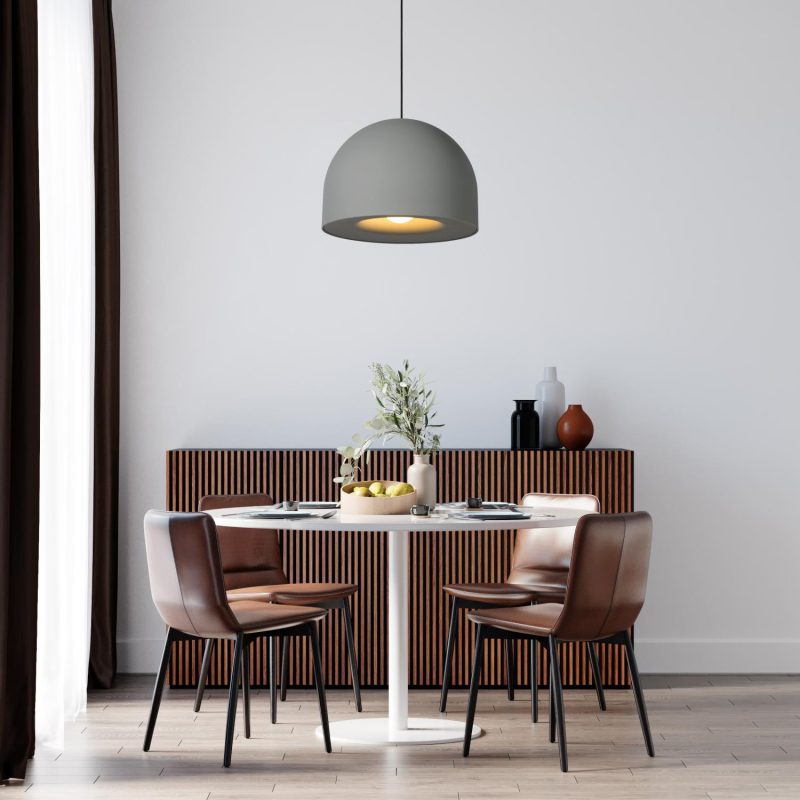
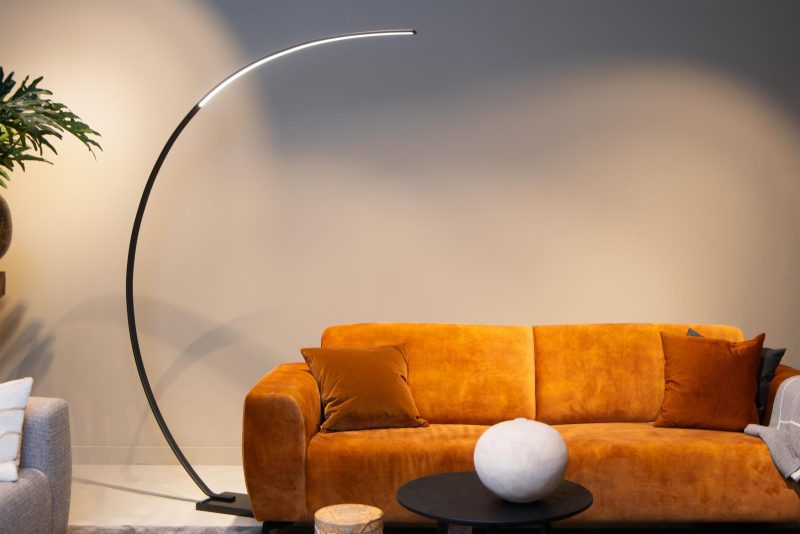
In a room with a high ceiling or a double-height space you hang the light close to the people, not close to the ceiling: the bottom of a pendant light usually comes between 2.2 and 2.8 m above the floor, or 70 to 80 cm above a table. Illuminance falls with the square of the distance, so a lamp at 4 m gives a quarter of the light on the floor that it would give at 2 m. Combine one pendant light on a long suspension with wall lights at around 2 m that fill the volume.
You do not light a high ceiling from the ceiling. You bring the light down, to the height where people sit, walk and eat, and you let the walls show the volume. In practice that means one pendant light on a long suspension that fills the centre of the space, and wall lights at about 2 metres that light up the tall walls.
The most common mistake in a double-height space is a ceiling light or a row of recessed spotlights at 5 or 6 metres. On the drawing it looks clean; in reality the room sits in a vague, flat light in the evening, the walls stay dark, and replacing any lamp needs scaffolding.
How much light do you lose to height?
A lot. The illuminance from a point source falls with the square of the distance: twice as far means a quarter of the light on the floor, three times as far a ninth. A lamp that lights a table well at 2 metres above the floor gives only a quarter of that at 4 metres. That is the physics behind the feeling that a tall room never really becomes bright.
In practice it is a little milder, because walls and ceiling reflect some of the light. But in a double-height space those walls are far away and the ceiling is often dark in the evening, so it is safer to count on the strict figure. Two consequences:
- a lamp high in the room needs far more lumens for the same result below;
- and the only way to avoid that is to bring the light source closer, with a long suspension or with wall lights.
You can check how many lumens the room needs with the lumen calculator; with a high ceiling, choose the upper end of the range.
| Height of the lamp above the floor | Relative light on the floor | What that means |
|---|---|---|
| 2 m | 100% | starting point |
| 3 m | about 44% | a little more than half lost |
| 4 m | 25% | four times as many lumens needed for the same result |
| 6 m | about 11% | nine times as many lumens needed |
How low do you hang a lamp in a double-height space?
Hang the lamp towards the people, not towards the ceiling. A few rules of thumb from practice:
- Above a table: the bottom of the shade 70 to 80 cm above the tabletop, just as under an ordinary ceiling. The height of the ceiling changes nothing there. See also pendant light above the dining table.
- Above a walkway: the bottom at least 2.2 m above the floor, so that tall people can also walk underneath freely. More than 2.8 m reduces the effect of a long suspension.
- In a stairwell: let the lamp drop into the middle of the stair space, but measure from every step. The critical height is the one above the step where you come closest to the lamp.
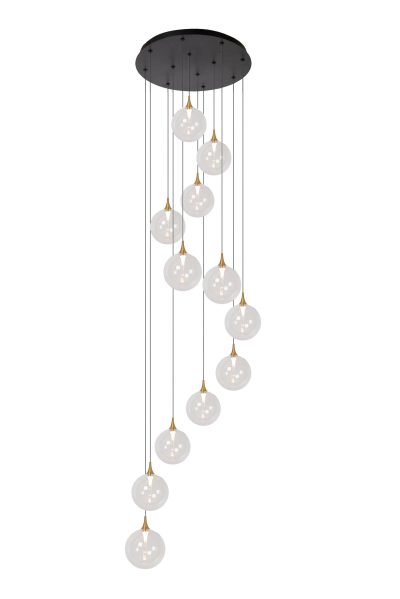
Check the maximum suspension length before you order. It varies greatly from lamp to lamp: many pendant lights have a cable of 1 to 2 metres that you can shorten but not lengthen. The Lucide Gisela below reaches a total height of 326 cm, which in a double-height space of 5 metres would bring the bottom to around 1.75 m above the floor: so there you would need to shorten it again, and that is possible.
One large lamp or several light points at different heights?
Both can work, and the choice depends on the shape of the space.
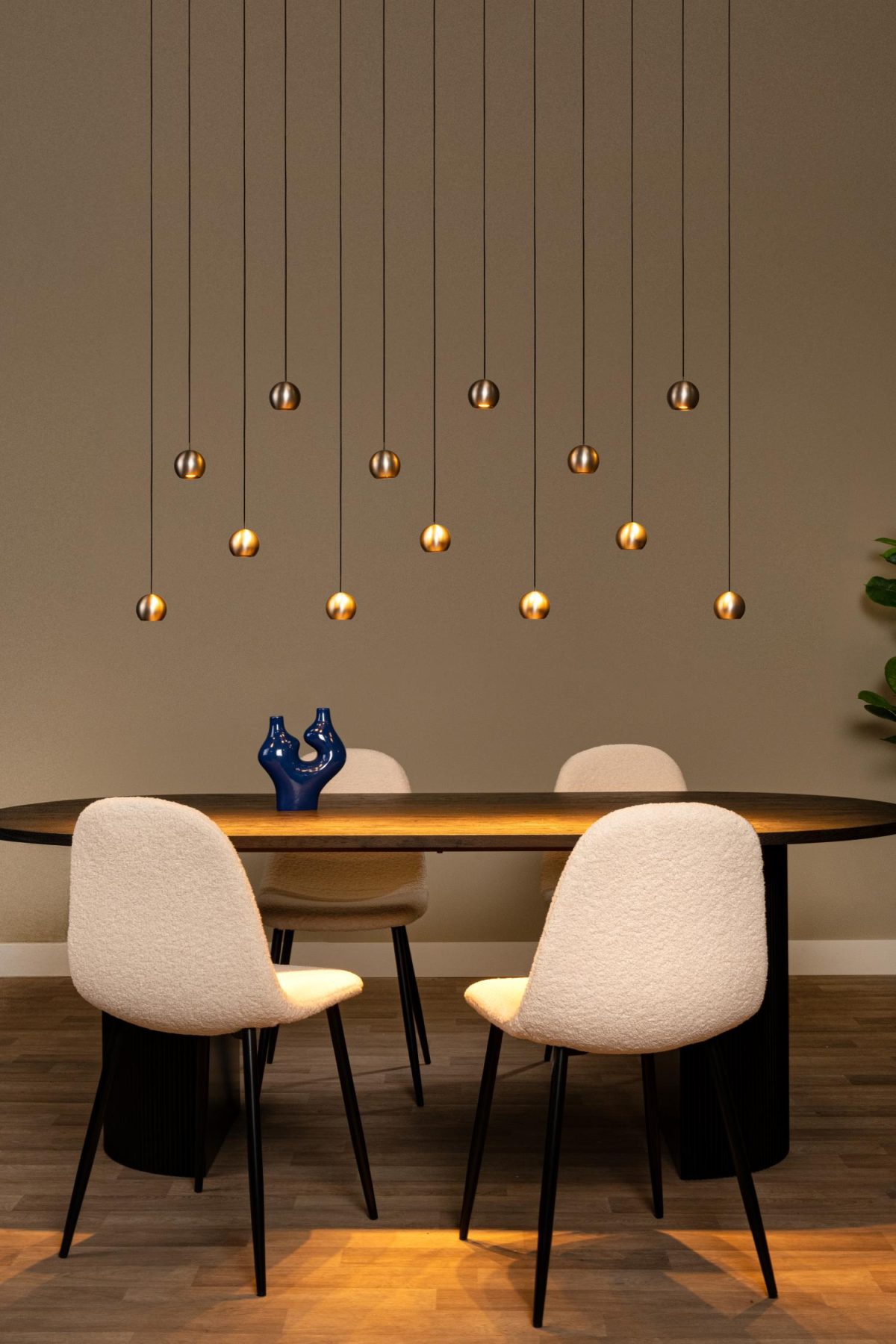
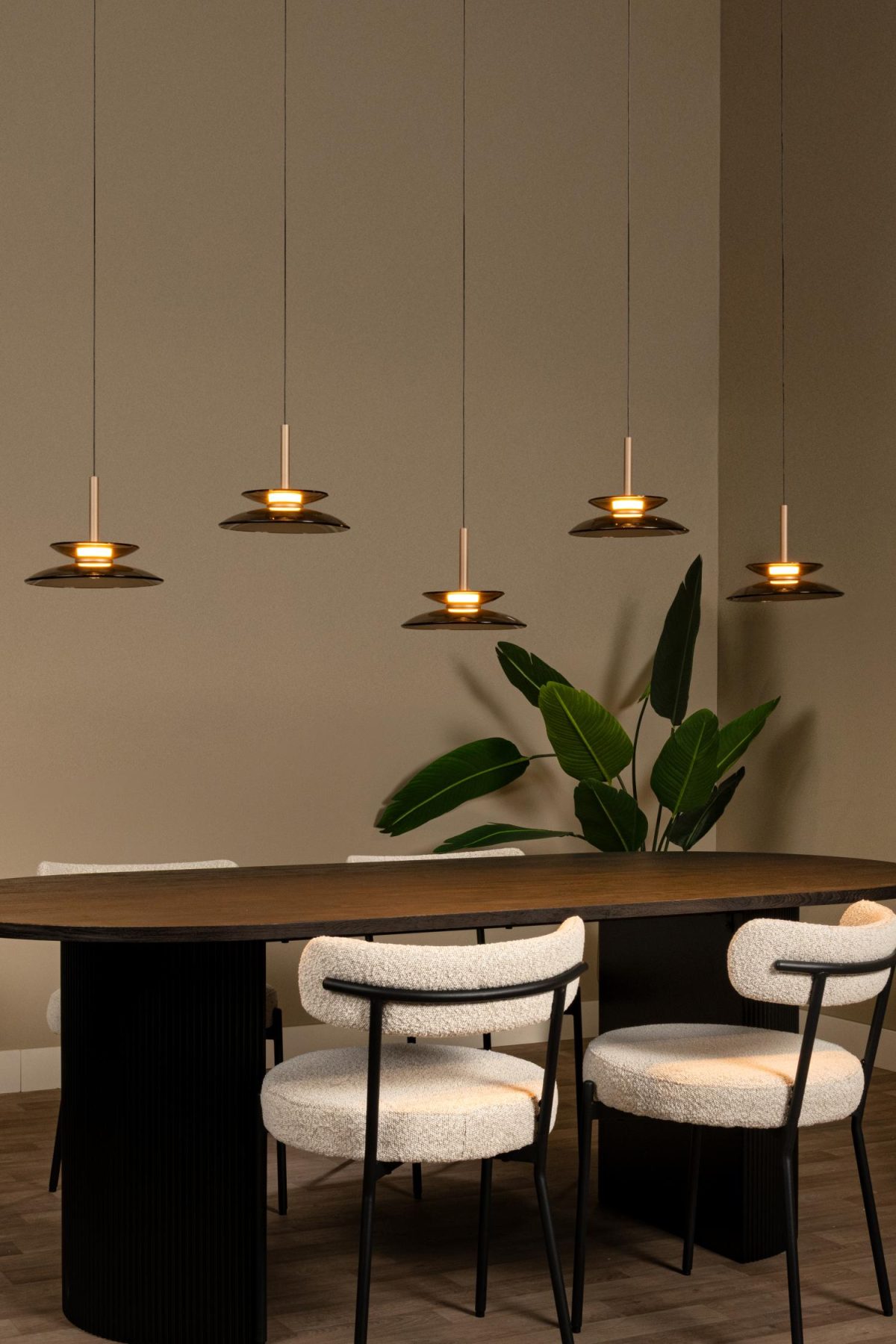
- A double-height space that is mainly tall and not very wide suits a lamp that is itself vertical: a cluster of pendants at different heights, or a series of lamps in a long cascade. It fills the height, and each pendant is closer to the people than one lamp at the bottom of a long cable.
- A wide, open space calls rather for one generous lamp or a long linear light fitting. There you want to spread the light over a larger area, not stack it in height.
Also think about the view from above. A double-height space has a gallery or a landing, and from there you look down on the top of the lamp. A shade that looks good from below can, from above, show a bare lamp holder or a bulb that shines straight into your eyes. In its explanation of glare, licht.de points out that a lamp without shielding causes the most glare. So choose a lamp that is shielded all round, with opal glass or a closed shade, or hang it so that the top stays below the eye level of the gallery.
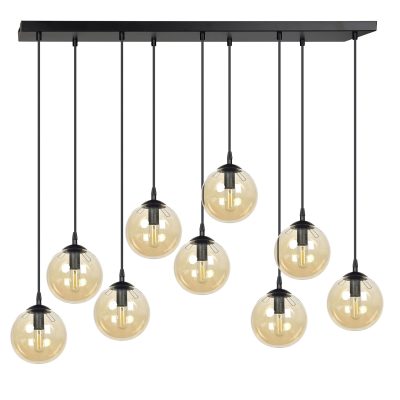
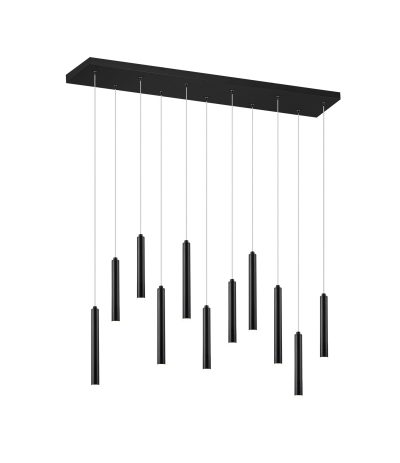
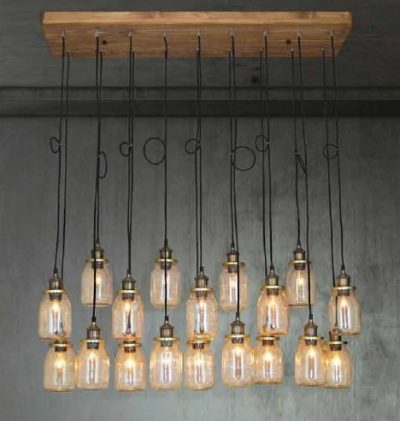
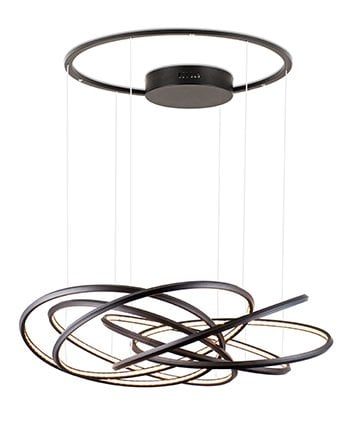
Pendant lights that find their place in a double-height space or stairwell
View allLarge or vertical pendant lights with a long suspension or many light points, from various brands.
Wall lights: the quiet strength in a tall room
A tall wall that stays dark makes a room smaller and gloomier than it is. Wall lights at about 2 metres do two things there: they give light at a human height, and if they also shine upwards, they draw bands of light on the wall that make the height visible. Writing about corridors, licht.de says that rooms appear larger and friendlier when walls and ceiling are brightened with indirect light; in a double-height space that principle works even more strongly.
A lamp that only shines at the ceiling, an uplighter, works less well in a double-height space than in an ordinary room. The ceiling is far away, so the reflected light arrives below weakened. Use uplighters to make the ceiling itself visible, not as the main light. More about height, spacing and light direction for wall lights is in solving an empty wall with wall lights.
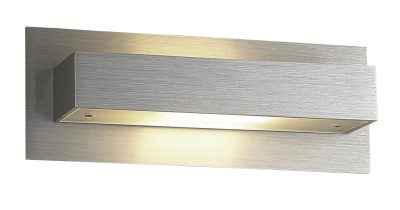 Fantasia Nenad wall lamp grey
A dimmable wall light that shines up and down at the same time, with 810 lumens. At 2 metres high it draws a band of light both upwards and downwards, so a tall wall does not disappear into the dark. €53.55
Maintenance: think of the day a lamp fails
What hangs at 5 metres is not something you quickly replace from a kitchen step. Three choices make that much less of a hassle later:
- Choose LED with a long lifespan, and for a lamp with separate light sources, a brand and type you will still be able to find in years to come. With integrated LED you usually replace the whole lamp or a module when it fails, so ask whether the driver and the LED module are available separately.
- Control everything from below: dimmable via the wall switch or a wireless dimmer, so you never have to touch the lamp to change the mood. Read dimming LEDs first if you want to keep an existing dimmer.
- Cut the cable to the right length during installation. Shortening it later at 5 metres is a second day of scaffolding.
Frequently asked questions
Can I extend an ordinary pendant light for a double-height space?
Sometimes, but then you replace the cable or the steel wires, and that falls outside the warranty of most lamps. It is better to choose a lamp for which the manufacturer specifies a long suspension straight away, or to have an electrician fit an extended suspension with material suitable for the weight of the lamp.
Are recessed spotlights in a 5-metre ceiling a good idea?
As the only light, usually not. You need a lot of lumens to get enough light below, spotlights with a narrow beam create pools of light, and every fault needs an aerial work platform. Spotlights at that height do work for lighting a wall or a work of art, alongside light closer to the people.
Which colour temperature do I choose for a tall room?
The same as in the rest of the house, usually 2700 to 3000 K for a living space. A tall room with cooler light soon feels like a hall. More about choosing Kelvin in choosing a colour temperature.
How heavy can a pendant light be on a ceiling of hollow-core slabs?
That depends on the fixing, not on the lamp. Heavy chandeliers belong on an anchor made for that weight and that type of ceiling. With hollow-core floor slabs you only drill where the hollow channels are; if in doubt, ask the floor supplier or a contractor.
Sources
- licht.wissen 14: Licht für Wohnräume, licht.de (ZVEI) (2019)
- Direktblendung, licht.de (2026)