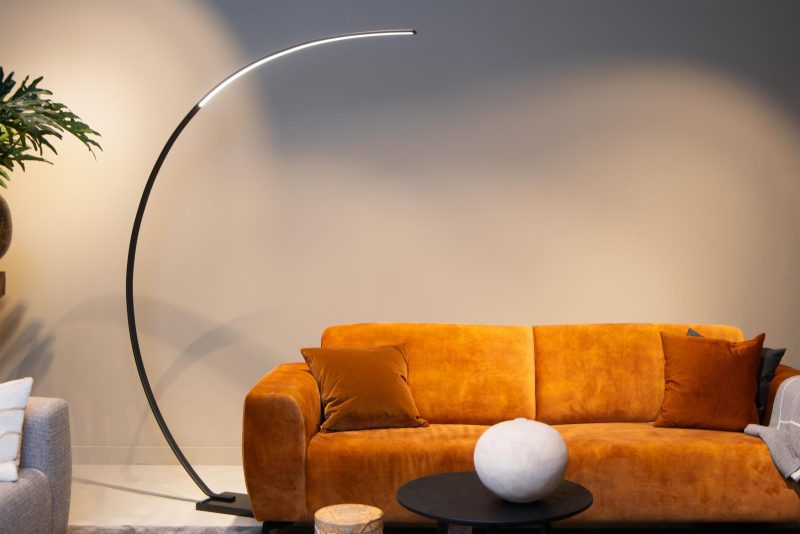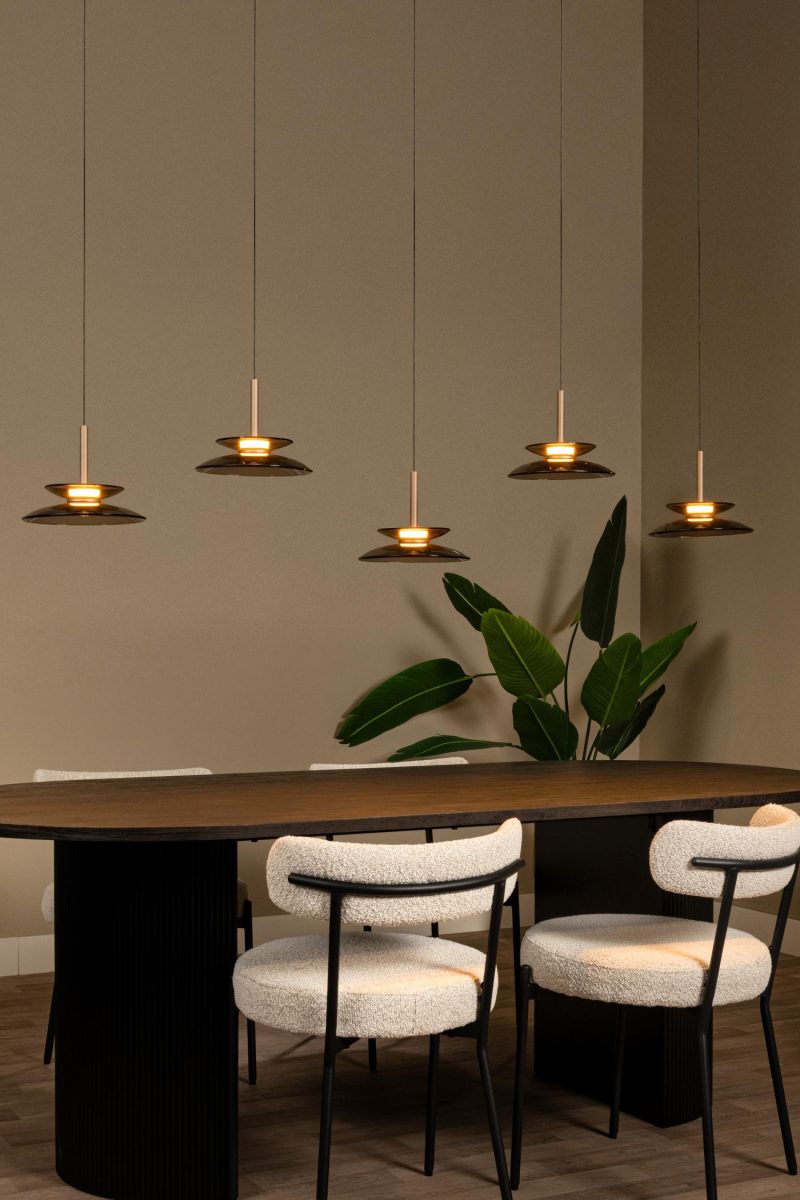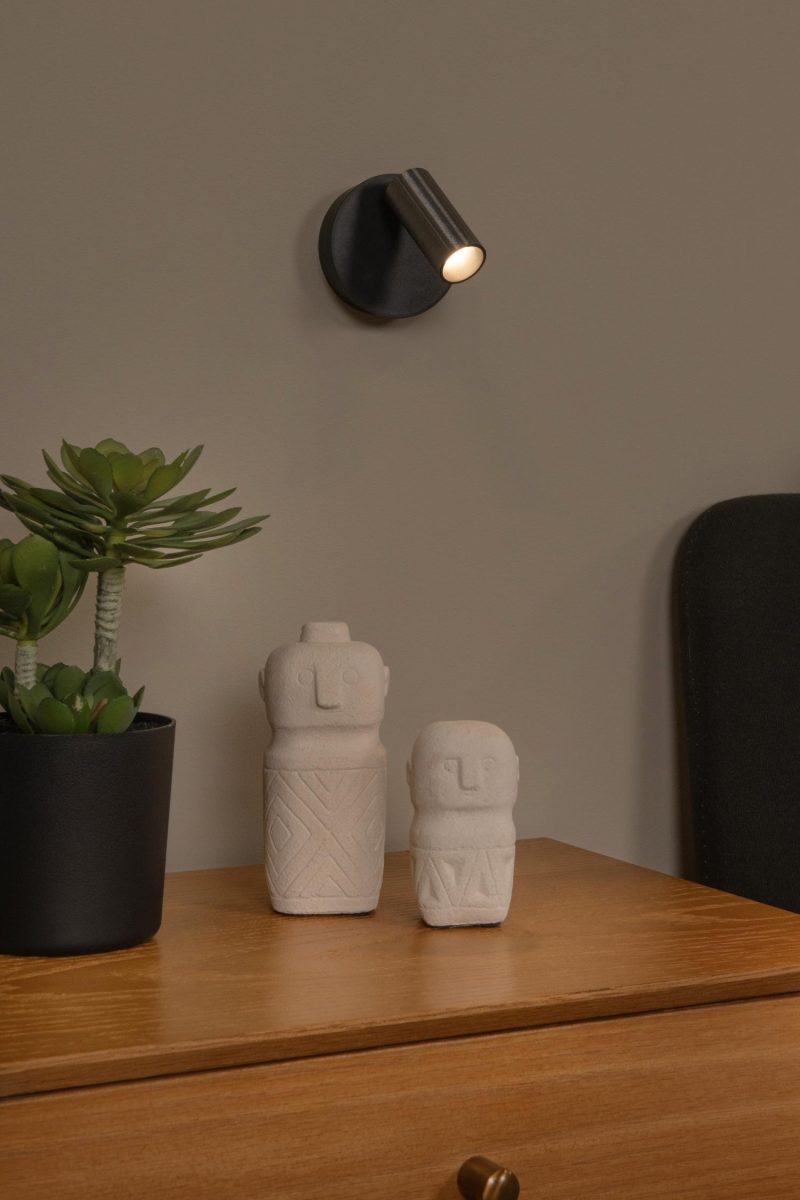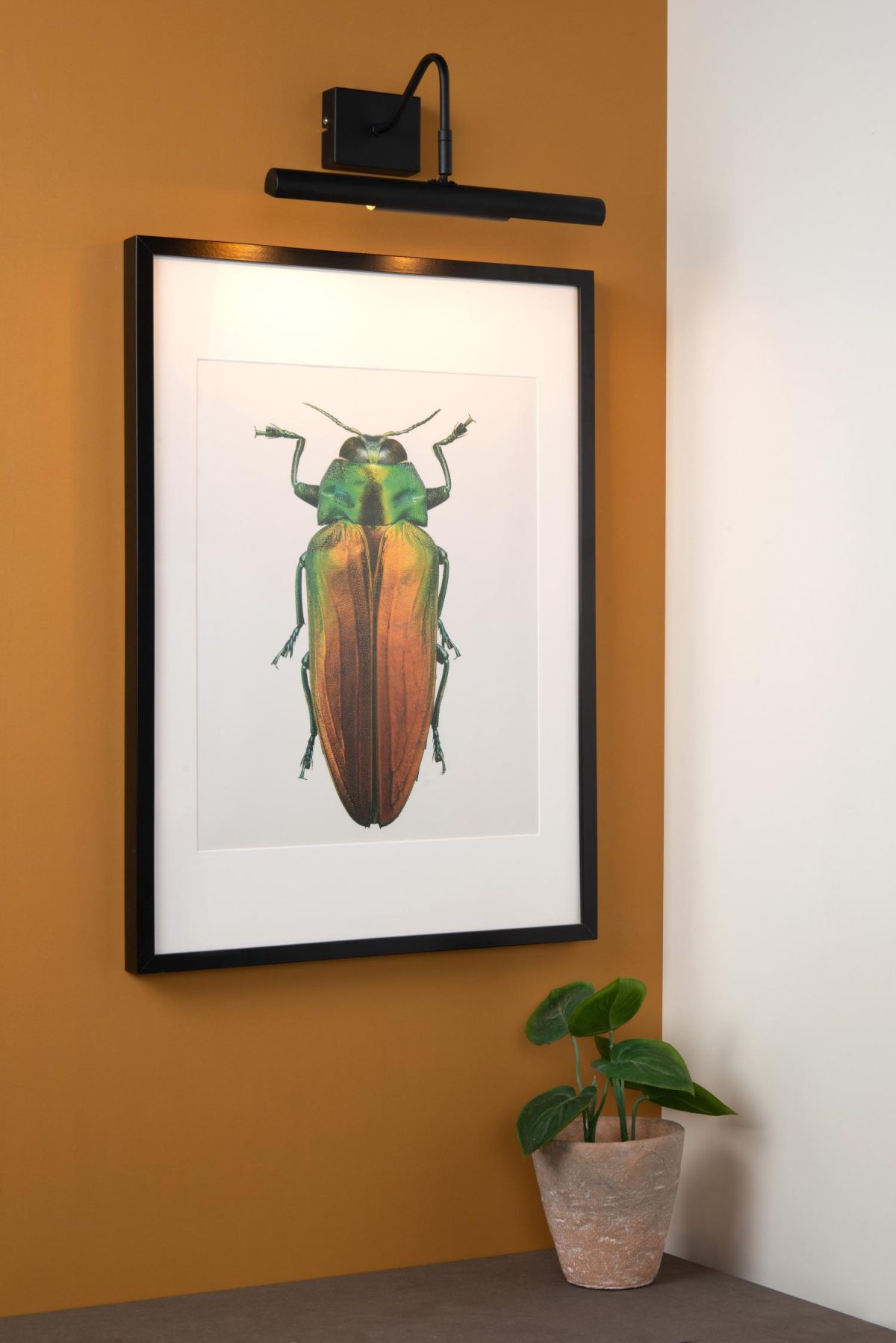
Wall lights that are meant to give atmosphere and light are usually hung at 1.6 to 1.8 m, just above eye level when standing, so that you do not look into the lamp. On a long wall you space them 1.5 to 2.5 m apart, with half that spacing to the corners, or you match them to the sofa or cabinet below. Light upwards makes a room look taller, light downwards makes it cosier, and light in both directions draws vertical bands of light that give an empty wall structure.
An empty wall only becomes a wall when light falls on it. Two or three wall lights at the same height, with light that grazes up and down the surface, turn a bare wall into a calm, structured plane. Hang them at 1.6 to 1.8 m, spread them evenly or match them to the furniture in front, and choose the light direction according to what the room needs.
Wall lights do something in a room that a ceiling light cannot. They bring light to eye level, they light vertical surfaces, and those vertical surfaces determine how light and how large a room feels. A room with a bright ceiling light and dark walls feels smaller than the same room with less light but light-coloured walls.
At what height do you hang wall lights?
For mood and room lighting: just above eye level when standing, usually 1.6 to 1.8 m to the centre of the lamp. That way you do not look into the light source as you walk through the room, and the light still has room to fan out upwards and downwards. With a high ceiling it can go higher; with a 2.40 m ceiling keep it lower, around 1.6 m, so that the upward light is still visible before it hits the ceiling.
A few exceptions:
- Reading light next to the sofa or bed hangs lower, so that the light falls on the book and not in your eyes. Use an adjustable wall light there with an arm or a head you can turn.
- Light beside a mirror hangs at around face height, to the left and right of the mirror. Licht.de recommends diffuse, low-glare light there from elongated lamps or lamps that shine indirectly onto the wall, and no spotlights aimed at the mirror.
- In a stairwell you measure from the steps, not from the floor. More on that in lighting stairs and hallways.
| Location | Height | Why |
|---|---|---|
| Living room, mood and room lighting | 1.60 to 1.80 m | Just above eye level when standing |
| Above a sofa | 1.60 to 1.70 m, at least 30 cm above the backrest | Nobody bumps their head on it |
| Reading lamp next to sofa or bed | Lower, adjustable; light on the book | Light from the side or from just behind |
| Hallway | 1.70 to 1.90 m | You walk past it, so not at eye level |
| Beside a mirror | Around face height, on both sides | Even light on the face |
How many wall lights, and how far apart?
On an open wall an even distribution works: 1.5 to 2.5 m between the lamps, and half that distance between the outermost lamp and the corner. Closer together and the bands of light merge into one surface; further apart and you get separate spots with dark strips in between.
If there is a piece of furniture against the wall, that furniture sets the rhythm. Two wall lights on either side of a sofa or a sideboard, each 20 to 40 cm beyond the end, look calmer than three lamps neatly spread across the wall but not across the furniture. If there is a window or a door in the wall, match the lamps to it: symmetrical around the opening, or in line with the frames.
Light upwards, downwards or both: what is the difference?
The direction of the light changes the room more than the lamp itself.
- Upwards: the light falls on the top of the wall and on the ceiling, and comes back softly from there. The room looks taller and more spacious. Writing about corridors, licht.de says that they feel larger and friendlier when walls and ceiling are brightened with powerful indirect light.
- Downwards: a pool of light under the lamp, on the furniture and the floor. That gives islands of light, cosy but less spacious.
- Both directions: two bands of light, one upwards and one downwards, with the lamp as a dark band in the middle. That is the classic way to give an empty wall rhythm. On rough material such as brick, concrete or limewash, the light grazes across the texture and makes that texture visible.
- All round, through glass or fabric: a wall light with opal glass or a fabric shade gives light in all directions. Less graphic, but more usable light in the room.
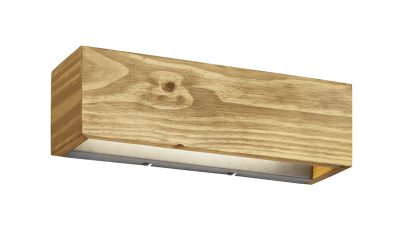
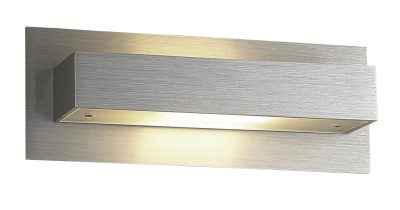
Wall lights that shine up and down
View allFor bands of light on the wall: from a slim GU10 wall light to a wide 1,500-lumen LED fitting.
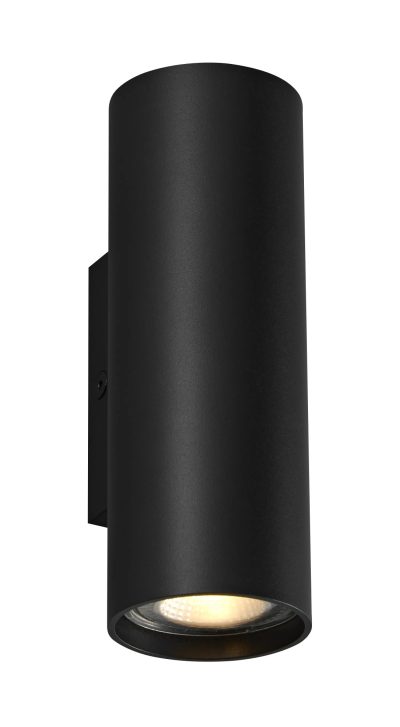
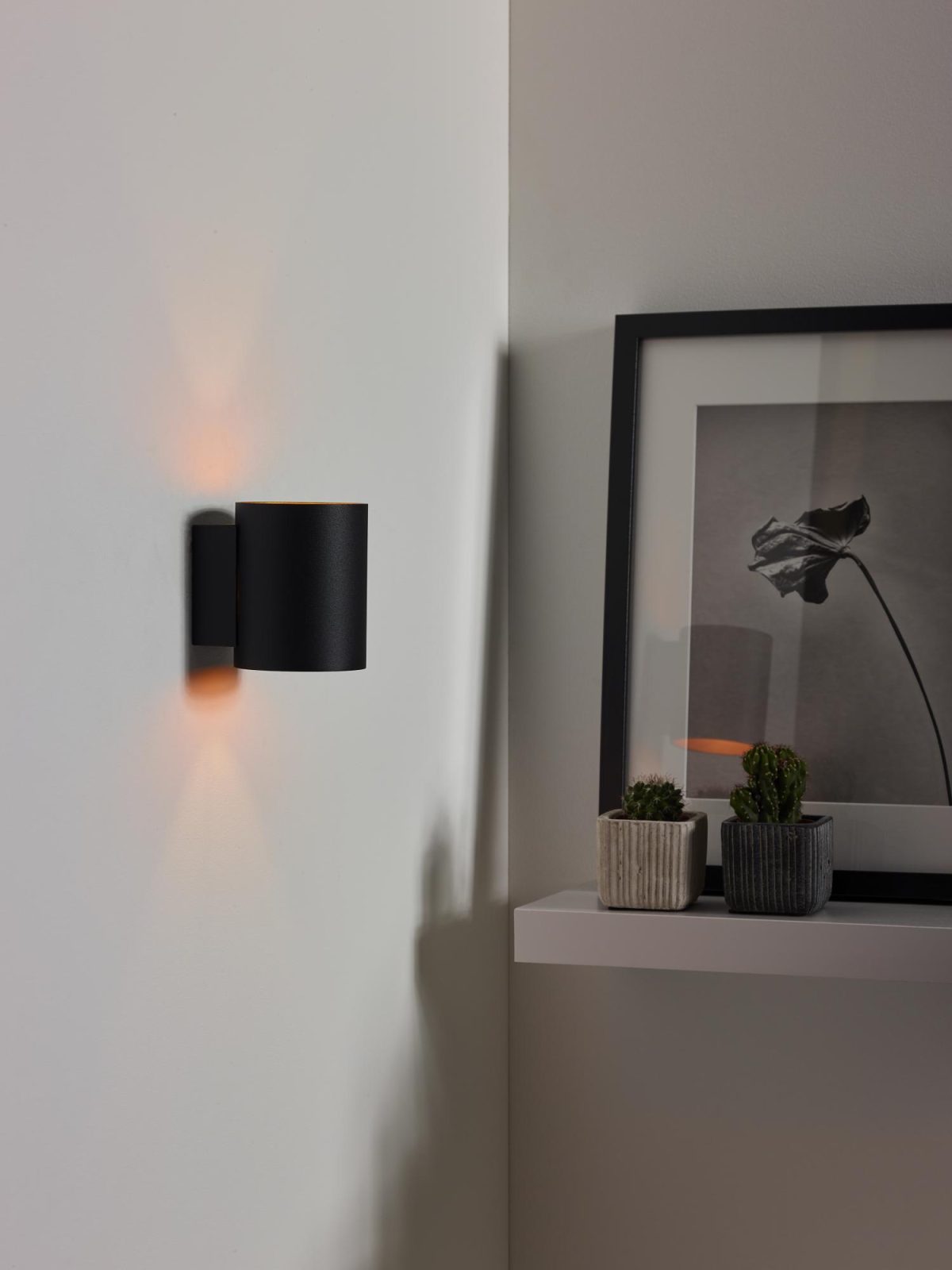
A wall with a painting or a cabinet
If there is art on the wall, you light the work and not the wall around it. Licht.wissen 14, the licht.de brochure on light in the home, gives a simple rule: the light should fall on the painting at an angle from above, from about 0.5 to 1.5 m from the wall. That way you get little reflection in glass or varnish. A picture light above the frame does the same from close by; a track system along the wall lets you move the spotlights when you change the art.
An open bookcase or a cabinet with objects looks best lit from the front and at an angle from above, with one or two adjustable wall spotlights or spotlights on a track, not with a lamp that shines straight down into the cabinet.
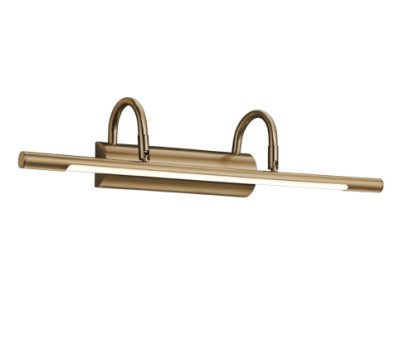 Trio Lighting Cuadro picture light grey satin nickel 480mm
A 48 cm wide picture light with 600 lumens at 3000 K. It hangs above the frame and lights the work from close by, without you needing a spotlight on the ceiling. €114.41
Lighting a TV wall without reflections
A dark wall with a bright TV screen is tiring to look at. Licht.de recommends lighting the area around the TV diffusely, for example with an LED strip behind the set, diffusely shining wall lights or well-shielded table lamps beside it. Aim everything so that you see no reflection on the screen: no spotlight straight at the TV, and no lamp opposite the screen that you see reflected in the black. More about LED strips in choosing an LED strip.
 Nordlux Stay wall lamp black
An adjustable, dimmable wall light with 700 lumens and a USB charging point. It works as reading light next to an armchair or the bed, because you aim the shade where you need it. €185.18
Frequently asked questions
Should wall lights be on the same switch as the ceiling light?
Preferably not. Wall lights are interesting precisely because you can switch and dim them separately, so that in the evening you sit with only wall light. If there is only one circuit, you can still control them separately with smart bulbs or a wireless switch.
How many lumens should a wall light have?
For mood lighting, 200 to 400 lumens per lamp is enough. If you want the wall lights together to light a room, count on 500 to 1,500 lumens per lamp, depending on the number of lamps and the size of the room. The lumen calculator gives the total for your room.
Can a wall light go in the bathroom?
Yes, with the right degree of protection for the zone in which it hangs, usually IP44 or higher next to the washbasin. See bathroom lighting and IP zones.
Which colour temperature do I choose for wall lights?
The same as the other lamps in the room, usually 2700 or 3000 K in a living space. Different colour temperatures side by side on one wall are noticeable straight away.
Sources
- licht.wissen 14: Licht für Wohnräume, licht.de (ZVEI) (2019)
- Wohnzimmer: Lichtanwendungen, licht.de (2026)