A staircase is well lit when each step stands out from the next with a short, soft shadow. You achieve that with light from above at the top landing or with wall lights that do not dazzle you on the way up or down, supplemented by orientation lighting at foot level on every step or at least every third one. Control the light at the top and the bottom, or with a motion sensor, and at night use warm, subdued light instead of full light.
You light a staircase to see the steps, not to show off the staircase. The light must make each step stand out against the next, it must not dazzle you when you look down, and it must be on before you take the first step. The rest, the design of the lamp and the colour, comes after that.
That is not a detail. In the Netherlands, in 2024 the fixed staircase was the product most often involved in a visit to the emergency department: an estimated 30,700 times, according to the injury figures of VeiligheidNL. How many of those accidents have to do with light is not stated, but licht.de names poor lighting as a common cause of falls on stairs: too dark, dazzling, or with shadows that confuse.
How do you see every step clearly?
Through contrast. Licht.wissen 14, the licht.de brochure on light in the home, puts it precisely: a staircase is well and safely lit when each step is distinguished from the next by a short, soft shadow. Completely shadowless light is not good either; then the steps merge into one surface. Hard cast shadows are no better, because they themselves look like a step.
Licht.wissen 14 also points out that most accidents happen on the way down. Then you look at the steps below you, and a lamp hanging at eye level in your field of vision dazzles at exactly that moment. Two arrangements work:
- Light from above at the top landing, so that the light strikes the steps at an angle from above and each nosing casts a short shadow.
- Wall lights along the stairs that are glare-free from every direction: shielded, with opal glass, or with the light directed at the wall and the steps instead of at your eyes.
For comparison: for stairs in schools and at work, the European standard EN 12464-1 sets a guide value of at least 150 lux, and 100 lux for corridors. At home that is not an obligation, but it is a useful benchmark if you are unsure whether the light is enough.
Orientation lighting on the steps: every step or every third?
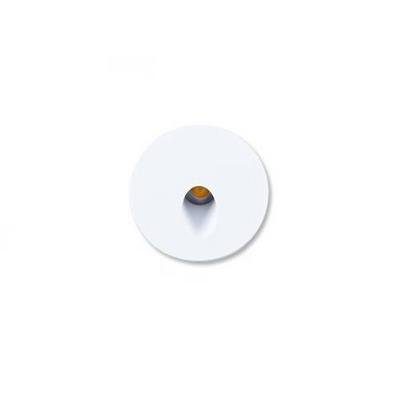
Orientation lights are small lamps at foot level, in the wall beside the stairs or in the risers, that direct their light only onto the steps. Licht.de calls them steplights. How many you need depends on how bright they are: according to licht.de, depending on the design, every step or at least every third step should be lit. If the lights are in the risers, each step must have its own light.
Orientation lighting does not replace ordinary lighting, but it solves something ordinary lighting cannot: showing the stairs at night without waking everyone up. A few small lamps with warm white light at low intensity are enough to find your way.
Lights recessed into the wall have to be planned during construction or a renovation, with a back box and wiring. If you do not have that, you can work with an LED strip under a handrail or along the skirting board, or with rechargeable lamps with a motion sensor. How to choose an LED strip is explained in choosing an LED strip.
Orientation lights and lamps with a motion sensor
View allFrom a recessed light for the stair wall to rechargeable lamps that switch on without wiring as you pass by.
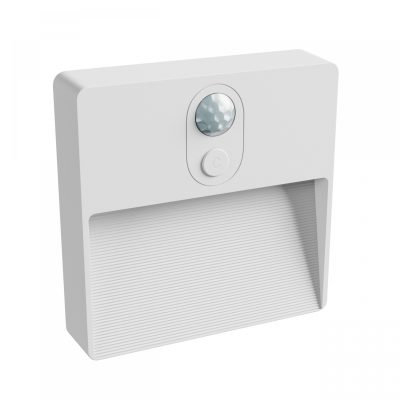
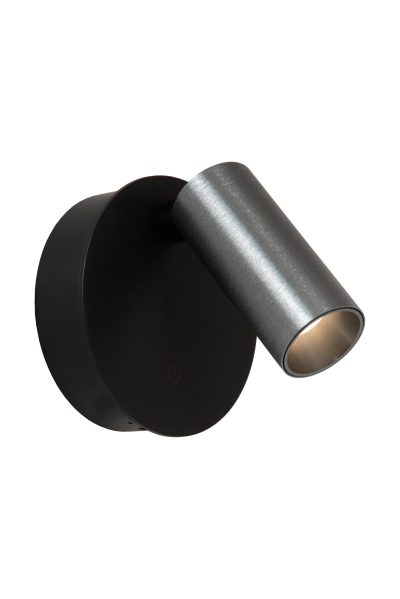
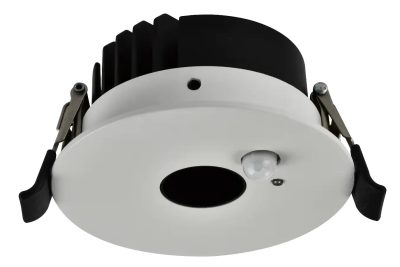
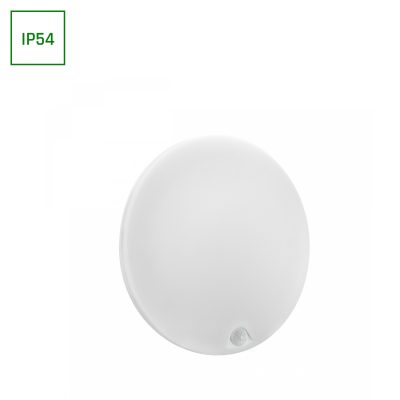
Switches at the top and bottom, or a motion sensor?
You need to be able to switch on the light on a staircase before you go up or down, so from both ends. That is done with two-way switching: a switch at the top and one at the bottom, both controlling the same lamp. In an existing home without that wiring there are two simple alternatives: a wireless switch that you stick to the wall at the other end, or lamps with a motion sensor.
A motion sensor reacts to movement and switches off again after a set time. Licht.wissen 14 calls motion and presence detectors practical and energy-saving, because the light is only on when it is needed and goes off by itself. Three things to watch:
- The run-on time: long enough to go all the way up or down the stairs without the light going off halfway.
- A dusk sensor: then the light does not switch on needlessly during the day.
- A night mode: better subdued warm light than full light at three in the morning. The French health agency ANSES points out that even small amounts of blue-rich light in the evening and at night disrupt the biological rhythm and sleep, and recommends warm white light at home, below 3000 K.
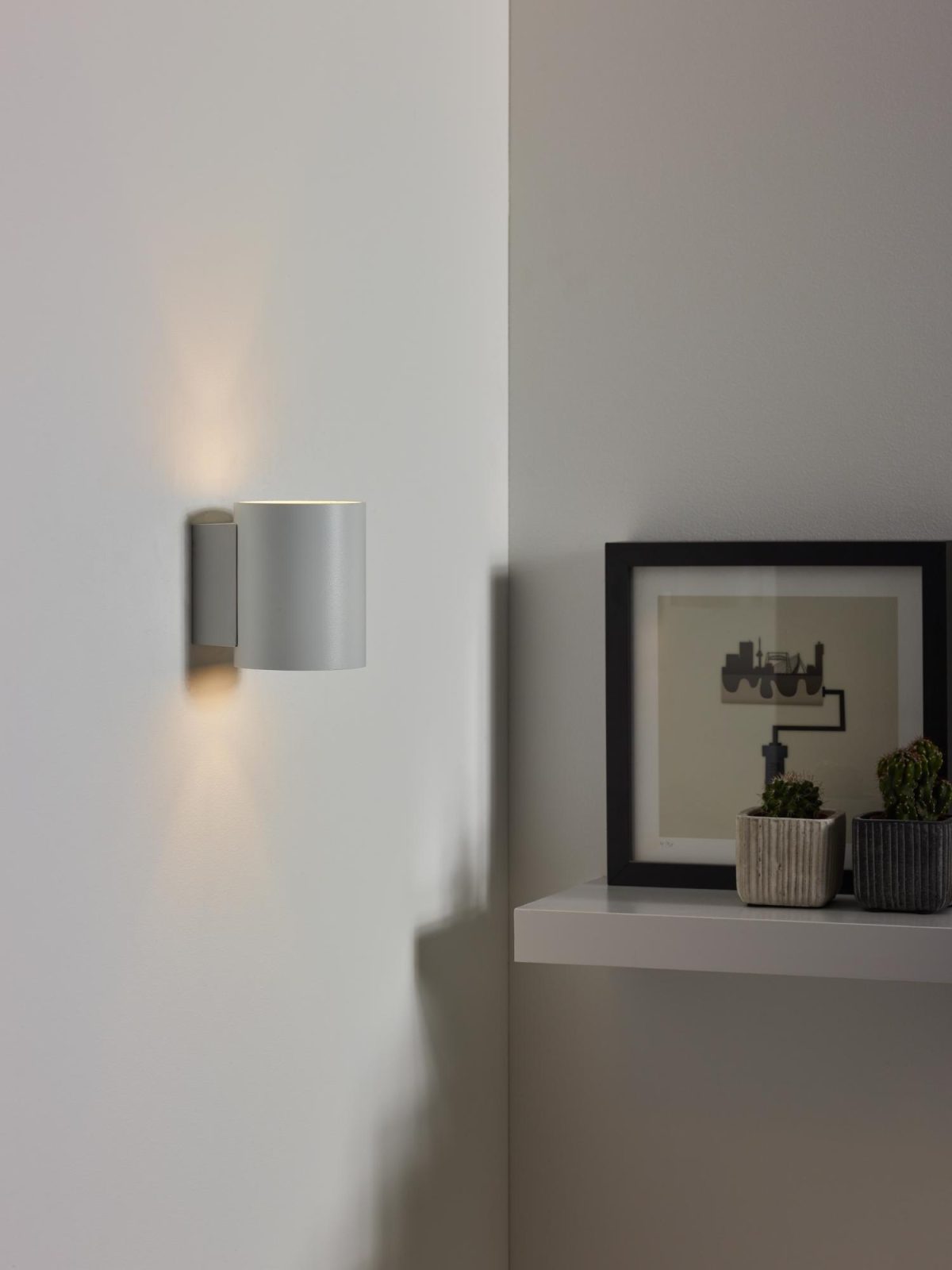
How do you light a hallway so that it feels more spacious?
A hallway feels larger and friendlier when the walls and the ceiling are light. For that, licht.wissen 14 recommends ceiling or wall lights that give a lot of light upwards and sideways. A row of narrow recessed spotlights that only lay circles of light on the floor makes a hallway narrower and darker instead.
A few practical rules:
- Wall lights in a hallway are hung a little higher than in the living room, around 1.70 to 1.90 m, because you walk right past them. Choose a model that does not stick out far.
- A mirror in the hall is lit with diffuse light to the left and right, not with a spotlight aimed at the mirror.
- One lighting point in a long hallway: a track with a few spotlights or a long linear light fitting brings the light along the whole length. Licht.wissen 14 calls track systems a good solution in the hallway, because you can position the lamps independently of the ceiling connection.
More about the height and spacing of wall lights is in solving an empty wall with wall lights.
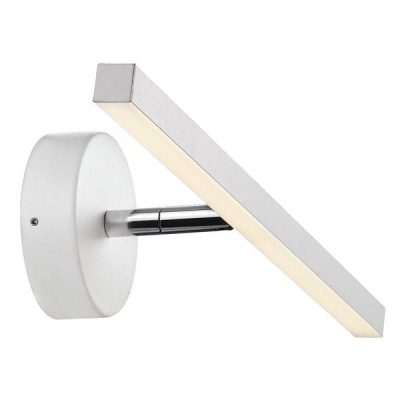 Nordlux IP S13 wall light 400mm white or brushed steel
An elongated 40 cm wall light with 415 lumens at 2700 K and IP44. It gives even light with little glare along a stair wall or in a narrow hallway, and can also hang in a damp room. €36.00
Frequently asked questions
Which colour temperature do I choose for a staircase?
Warm white, around 2700 to 3000 K, as in the rest of the house. For orientation lighting at night it can be even warmer and fainter. Cold light in a stairwell looks harsh and wakes you up at night.
Is an LED strip on every step a good idea?
It can look good and it lights every step, provided the strip itself is out of sight, under a profile or the nosing of the step. A visible strip in your field of vision as you walk down dazzles. Plan for a power supply and the cabling before you start.
Can I install two-way switching myself?
Two-way switching is work on the fixed installation. In Belgium the rules of the AREI apply, in the Netherlands NEN 1010; leave it to an electrician. A wireless switch or lamps with a sensor you can fit yourself.
How do I light a staircase with no socket nearby?
With rechargeable lamps with a motion sensor along the stairs, or a battery-powered LED strip with a sensor under the handrail. They give less light than fixed lighting, so use them as a supplement to the light in the hall and on the landing.
Sources
- licht.wissen 14: Licht für Wohnräume, licht.de (ZVEI) (2019)
- Treppen: Lichtanwendungen Gesundheit und Pflege, licht.de (2026)
- Flure, Treppen und Aufzüge: Schule und Bildung, licht.de (2026)
- Letsels 2024: kerncijfers, tabellen, VeiligheidNL (2025)
- LEDs: ANSES’s recommendations for limiting exposure to blue light, ANSES (2019)